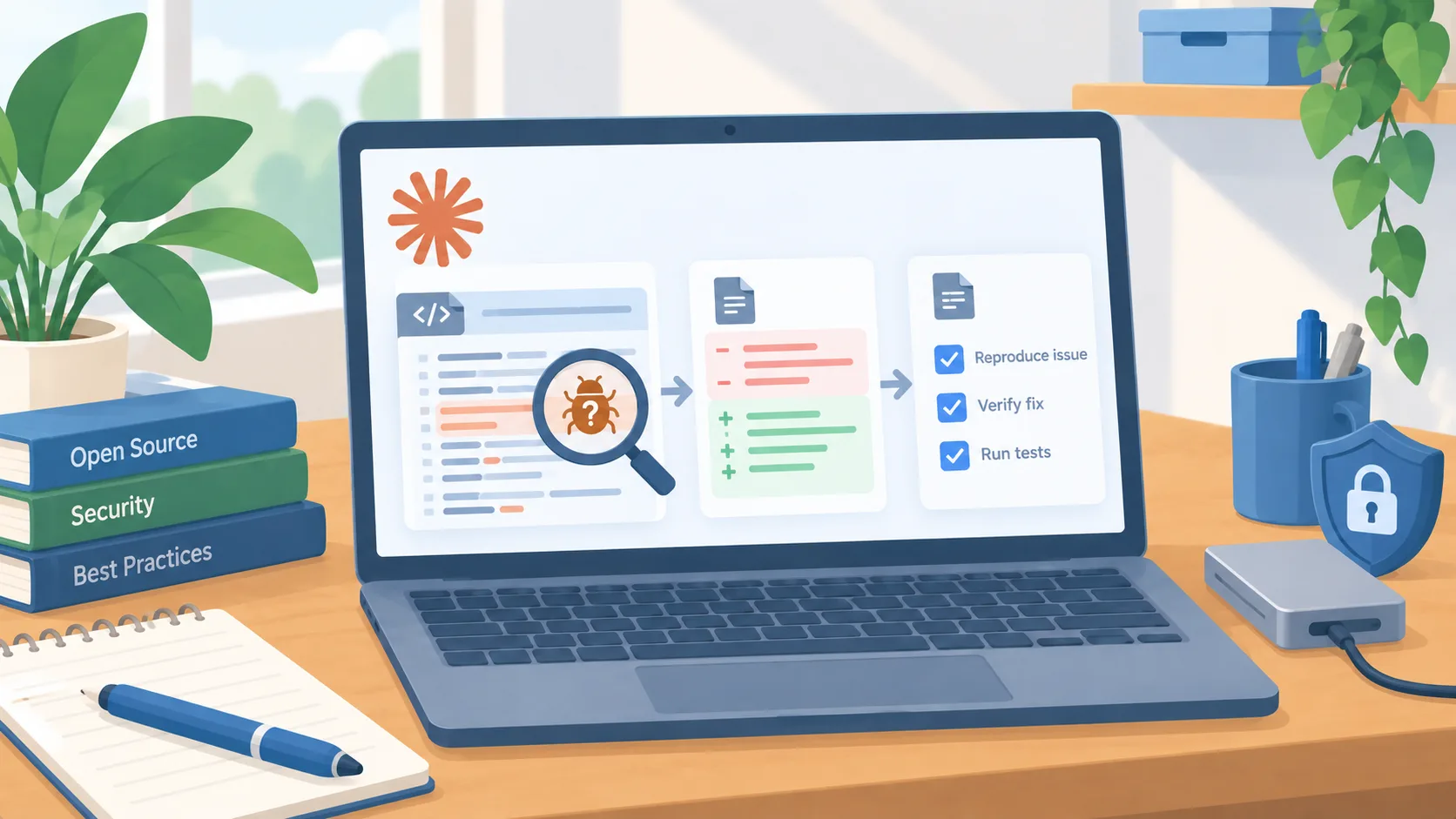
The scanner is an opt-in service for open-source maintainers
Anthropic announced the Cyber Mission on October 8, 2026, including work with critical-infrastructure defenders and open-source software. Its OSS Scanner is an opt-in service for enrolled open-source projects. Anthropic says projects receive periodic scans from its models at no charge, with reports that may include an explanation and suggested fix. The announcement does not describe a general scanner for every business application.
Anthropic says these reports are model-generated and sent without human review. That makes them inputs for maintainer investigation, not a security verdict. A business using the announcement as a prompt to review its own software should confirm service eligibility and data handling directly rather than assume its private code can be submitted.
A model report is an input to security work, not its conclusion
A model-generated finding can be wrong, incomplete, or irrelevant to the way a component is deployed. A proposed fix can also introduce a regression. Treat the report as a lead that needs reproduction, context, and a controlled test. The important question is whether the team can validate the finding and close the loop, not whether a scanner can produce a detailed explanation.
Security work can be delayed by both false alarms and real issues that nobody owns. A team should decide who can reproduce a report, who evaluates its severity, and who approves a patch before adding another alert source. If those responsibilities are unclear, new findings may increase workload without improving the software.
Decide who owns triage before adding another alert stream
Before opting into any recurring security scan, name the person or group that will receive findings and define how they will be reviewed. If a project has no maintained release process or nobody able to test proposed changes, a scan can create obligations the team cannot meet. A small maintenance group may need to set a narrow review window and a clear escalation path before accepting a new source of reports.
For each finding, capture the affected component and version, the conditions needed to reproduce it, the potential impact, the evidence, and the proposed correction. Keep the report restricted to people who need it while it is being assessed. Avoid pasting sensitive code or vulnerability details into unrelated tools or public issue trackers merely to get another opinion.
Keep verification and patching separate from discovery
A responsible workflow has distinct steps: receive the report, reproduce or independently inspect it, assess severity in the project’s real context, decide whether the issue needs a fix or disclosure, test the patch, and release through the project’s normal process. The scanner may accelerate discovery, but it cannot establish that the patch is safe for every downstream user. Preserve a record of what was checked and who approved the resolution.
If a report includes an exploit proof of concept, handle it as potentially sensitive security information. Use a controlled environment and avoid running unknown code against production systems. A proposed patch should be reviewed by someone familiar with the affected component. If the finding is not reproducible, document the steps and ask for clarification through the service’s stated process rather than silently dismissing it.
For a business, start with dependency and response ownership
Most businesses do not maintain the open-source projects they depend on. Their useful first move is to inventory important software components, identify who supplies security updates, and establish who evaluates a warning that affects their own deployment. If your business does maintain an eligible open-source project, assess the team’s triage capacity before opting into recurring model-generated findings.
A scanner is valuable only when a finding can move through a trustworthy path to a verified fix or a documented decision. Ask what project scope is eligible, what data the scan receives, how reports are delivered, and how maintainers should validate a result. Then assign an owner for each step. The key decision is whether your team can absorb another source of findings and act on it with care.