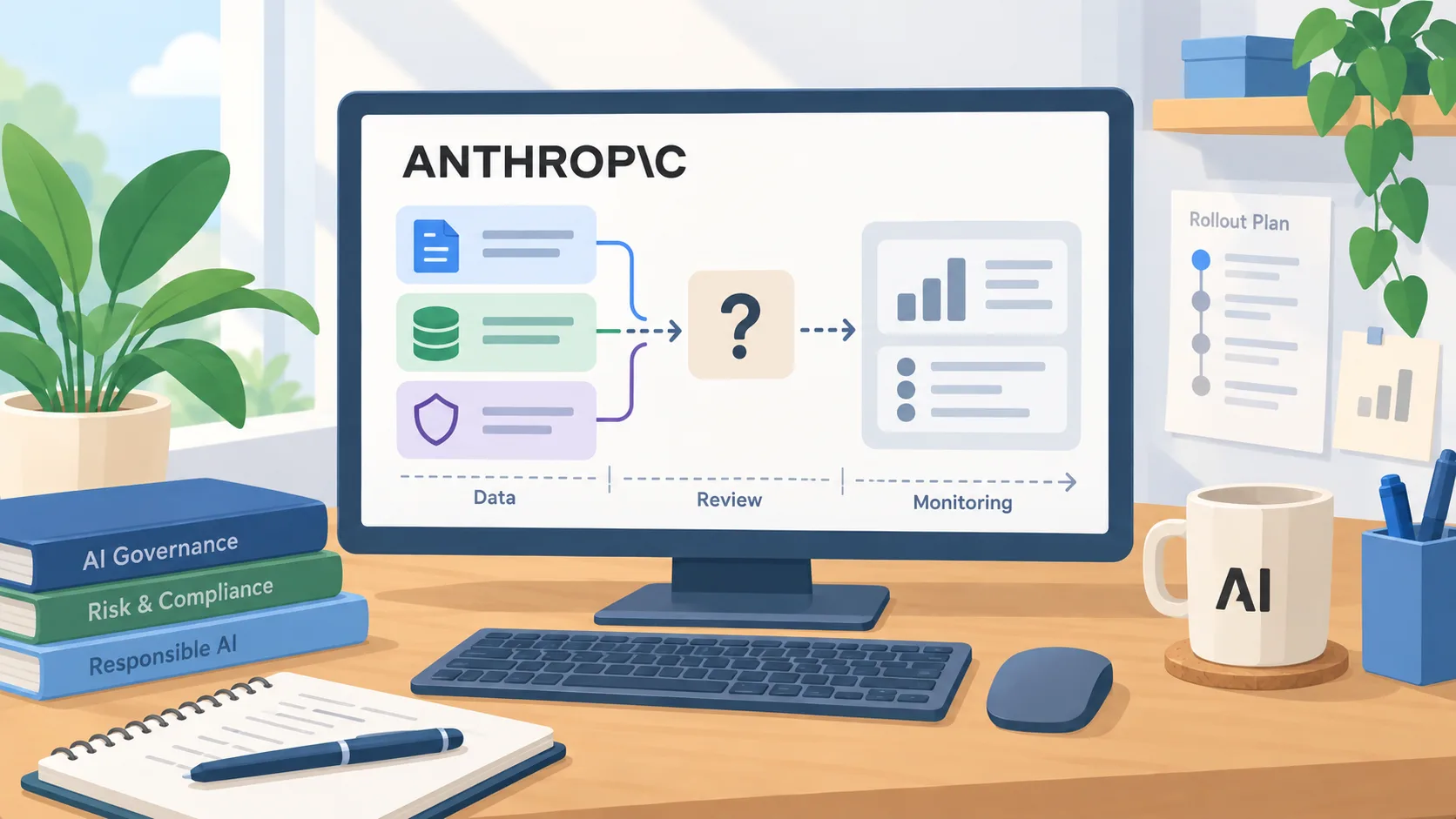
The announcement pairs monitoring with customer-controlled storage
On September 1, 2026, Anthropic announced Enterprise Frontier Safeguards, or EFS. The company described it as combining misuse detection with activity data stored in cloud infrastructure controlled by the customer rather than Anthropic. Anthropic said the service would roll out in phases, with broad availability targeted for later in the fall. It also described customer-owned storage, customer-managed encryption keys, and automated review as opt-in controls. The announcement is a product plan, not proof that a given account already has the feature or that every data path uses it.
That distinction matters to a buyer. “Customer controlled” can describe where selected logs are stored, while model inputs, outputs, account metadata, support records, and security events may follow different retention rules. A useful review starts with the data flow and asks exactly which records move, who can read them, and how long they remain available.
Turn the announcement into a diligence checklist
Ask the vendor to identify the covered products, models, cloud platforms, regions, and customer eligibility rules. Confirm whether storage controls are on by default or require configuration, which team controls encryption keys, and whether support or incident response access is possible. Ask how a misuse alert is generated, what information it contains, who receives it, and what action the vendor may take. Request the retention and deletion behavior for each data category instead of relying on one broad “zero retention” phrase.
Then walk through a realistic example. If an employee asks a model to analyze a sensitive document, determine which content is retained for service delivery, which event data is collected for safety, where those records reside, and whether administrators can review them. Repeat the exercise for API use and for any cloud marketplace or reseller path. The answer may differ by surface.
Treat rollout timing as part of the decision
Anthropic’s post said EFS would roll out in phases, starting later in fall 2026. If a purchasing decision depends on this control, verify that the exact account and intended model are eligible before making it a requirement in your architecture. Ask for documentation describing the live configuration and test the behavior with non-sensitive data. A planned feature should not substitute for a control currently available and enabled.
There is also an operating cost question even when a provider does not charge for the safeguard itself. Customer-side storage, reads, writes, and data transfer can have separate cloud charges and ownership. Identify the account that pays them and the team responsible for retention, access reviews, and incident response.
The decision is about control, not a label
EFS points to an important procurement pattern: privacy and misuse monitoring do not have to be evaluated as competing slogans. They can be assessed as separate technical and operational controls. Buyers still need to verify what is actually live, what data each control touches, and who can act on a signal. For a small team, a short data-flow review with security, operations, and the business owner is a better next step than assuming an announcement settles the deployment question.