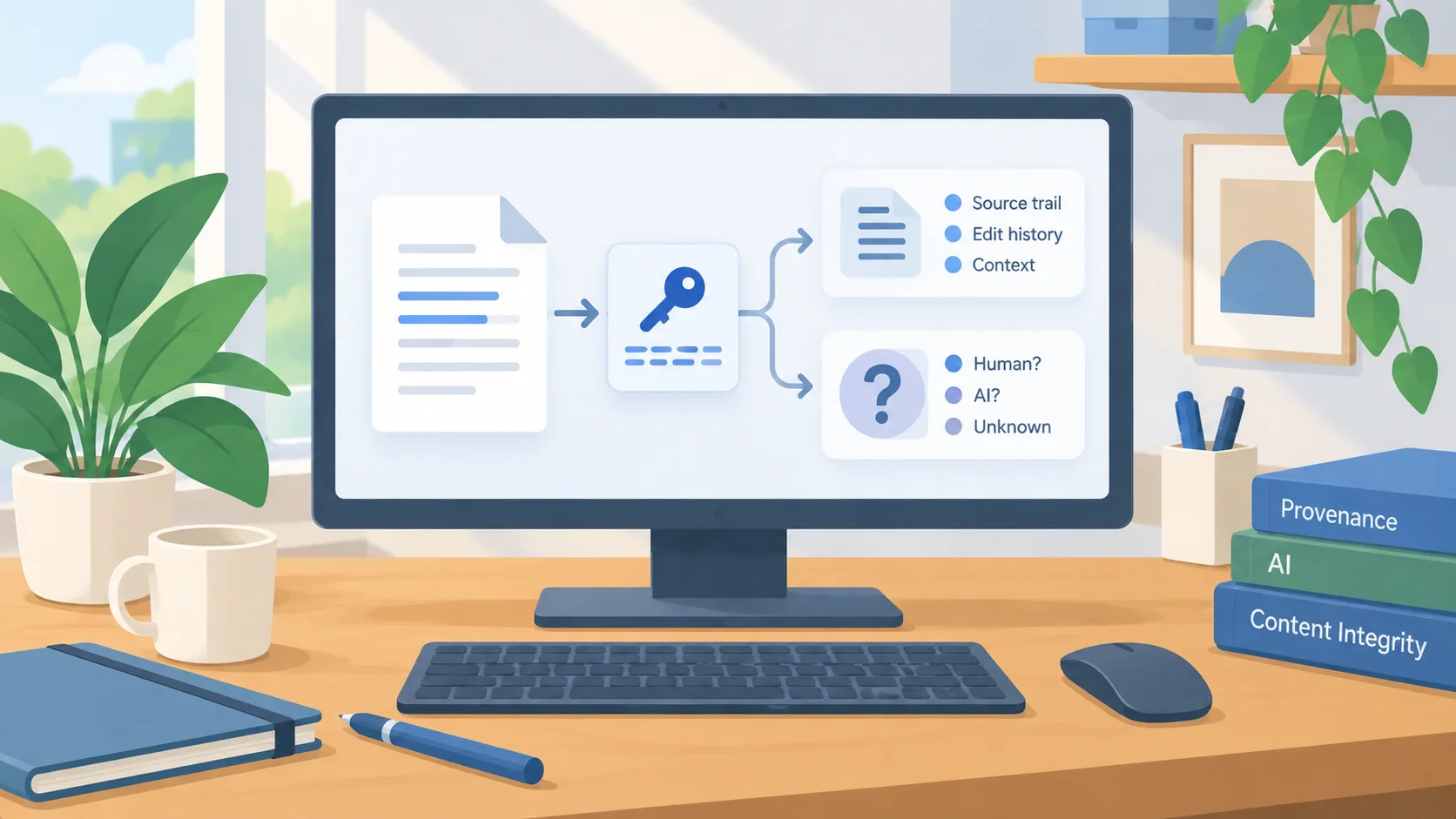
The announcement describes a likelihood signal
Anthropic announced on August 14 that future Claude models would generate watermarked text. The company describes the mark as a pattern that can be checked with a key to estimate the likelihood that Claude was involved. It says the mark is not visible to readers, does not add hidden characters, and carries no identifying information about a user, organization, or chat. Anthropic also says the mark can’t distinguish text Claude wrote from text it heavily edited.
That distinction matters for a business using AI in drafting, review, or translation. A watermark is not a signature attached to a named employee, and it does not establish who authored a passage. It also does not establish that the passage is accurate, authorized, original, or suitable for publication. The announcement describes a probability of Claude involvement, rather than a definitive authorship verdict.
Do not make personnel or customer decisions from a detector result
A false sense of certainty can create real problems. Do not use a watermark result alone to accuse an employee, reject a contractor’s work, deny a customer request, or represent that a person used AI. Anthropic notes that detection is less effective on short samples and on passages with few discretionary word choices, such as factual writing or light proofreading. A full rewrite can also remove the watermark. Those limits make the signal a poor fit for individual-level judgments.
If a business needs to understand how a document was produced, ask for the process evidence that fits the work: approved source material, reviewer identity, factual checks, version history, and any required human sign-off. Keep a record of whether AI assistance was permitted and what disclosure the recipient needs. A probabilistic watermark may be one additional clue where available; it should not replace those records.
Separate provenance from content quality
A document can carry a signal of AI involvement and still be correct or incorrect. A human-written document can also contain errors. Review the substance against the underlying sources and the purpose of the document. For factual statements, validate the supporting records. For customer communications, check that the message is accurate, appropriate, and approved. For code or structured data, use tests and validation rules rather than trying to infer authorship from text patterns.
The watermark also does not say whether AI assistance was appropriate under a contract, client policy, or internal standard. Those are governance questions that require the actual rule and the facts about how the output was used. If your organization relies on an authorship or originality standard, define it directly and tell staff what documentation is expected. A technical likelihood signal cannot resolve an unclear policy.
Set expectations before the feature arrives
Anthropic said watermarking would apply to future Claude models, with older models to be addressed later. A business should avoid assuming that all Claude outputs are marked today or that every text surface supports detection. For any process where provenance matters, ask the provider which models and workflows are covered, what the detection result means, and how the tool handles short, factual, translated, or edited material. Treat the answer as a product capability to verify, not a promise of universal detection.
The practical step is to update your writing and review policy with a narrow rule: use watermarking, if available, as a signal that can prompt a closer process review, never as stand-alone proof of authorship. Preserve ordinary evidence about who prepared and approved the work. That gives a business a more dependable record whether a document was drafted by a person, generated with AI, or revised by both.