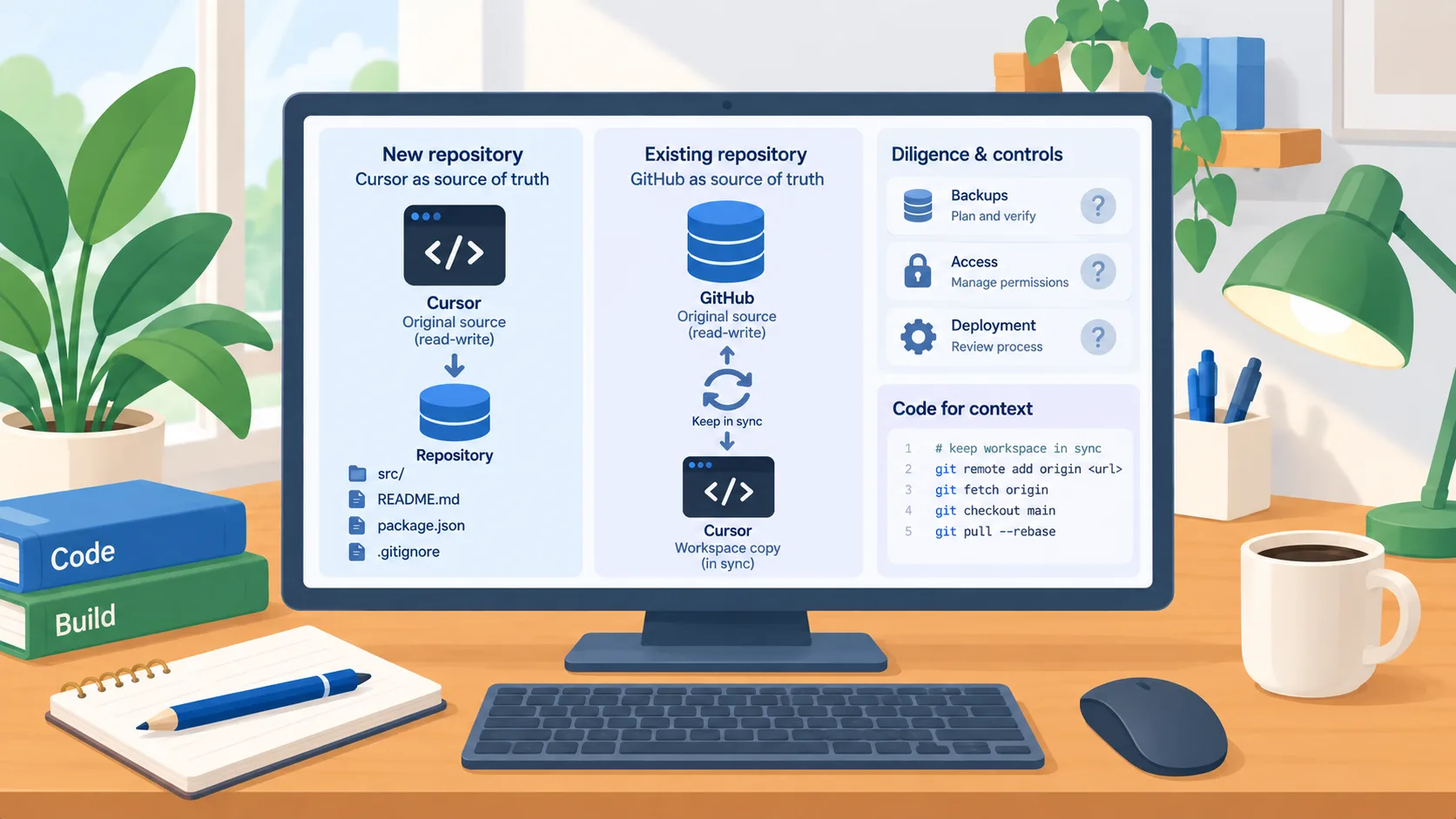
Cursor Origin gives a code editor its own hosting option
Cursor announced Origin code hosting on August 17, 2026, beginning an early beta rollout for paid plans. Its first feature set includes hosted repositories, pull requests, code browsing, and GitHub sync. The launch also lists integrations with Vercel, Depot, and Buildkite. Cursor says an Origin-hosted repository has Origin as its source of truth. For a GitHub repository brought into Cursor, the GitHub copy remains the source of truth and syncs with Cursor.
That distinction matters more than the new interface. A company can now choose a different home for new code, or connect existing GitHub repositories while keeping their current owner of record. Those are different operating choices with different backup, access, automation, and exit questions. The feature is in early beta, so availability and behavior should be confirmed in the account before a team plans around it.
Keep the repository owner explicit
Before trying Origin, write down where the authoritative copy of each test repository lives. For a GitHub-synced project, verify that pushes still go to GitHub and understand how conflicts or a paused connection are handled. For a repository created on Origin, treat Cursor as the primary host: decide how you will make independent backups, who may administer the organization, and how a repository would be moved if the service no longer fits. Do not infer that a synchronized repository is a complete disaster-recovery plan without testing recovery yourself.
Pick a low-risk project with no customer data, secrets, or production deployment credentials. Have one person create or connect it, then ask another authorized teammate to clone, branch, open a pull request, review a change, and confirm the resulting state in both systems. Record which system accepted each push and where the merged commit can be found. This simple exercise can uncover uncertainty about what the team considers canonical before the choice spreads to more repositories.
Review access and connected build services
A repository is also a set of permissions and integrations. Cursor’s launch information describes repository access settings and app connections, and the listed integrations can run builds or create preview deployments. Review each connected service’s account, permissions, and expected behavior before enabling it. In particular, determine whether a pull request can trigger a build, whether a preview can reach non-public data, and who is able to approve a merge or production release.
Keep existing branch protections, required reviews, secrets handling, and release approvals in view. A convenient agent workflow does not automatically replace them. If an agent can create branches or update pull requests, define which actions it may take without approval and which require a human reviewer. Test those boundaries on the low-risk repository, including the failure path: a failed check, an unexpected change, and a disconnected GitHub sync.
Run a bounded pilot before moving important code
For the pilot, compare the new workflow against the one developers already use. Track practical observations such as setup steps, review handoffs, sync clarity, and whether the team can find the authoritative version after a change. Do not assume that fewer context switches means lower total cost or faster delivery; measure the work in your own environment and include the time spent on permissions, recovery, and migration planning.
A sensible first decision is whether Origin should host a disposable internal project or merely sync an existing test repository. If the team cannot explain where the source of truth sits, how to recover it, and which integrations can deploy, pause before expanding the pilot. The benefit of an agent-centered repository workflow is only useful when ownership and release controls remain clear.