The change is real, but the rollout is staged
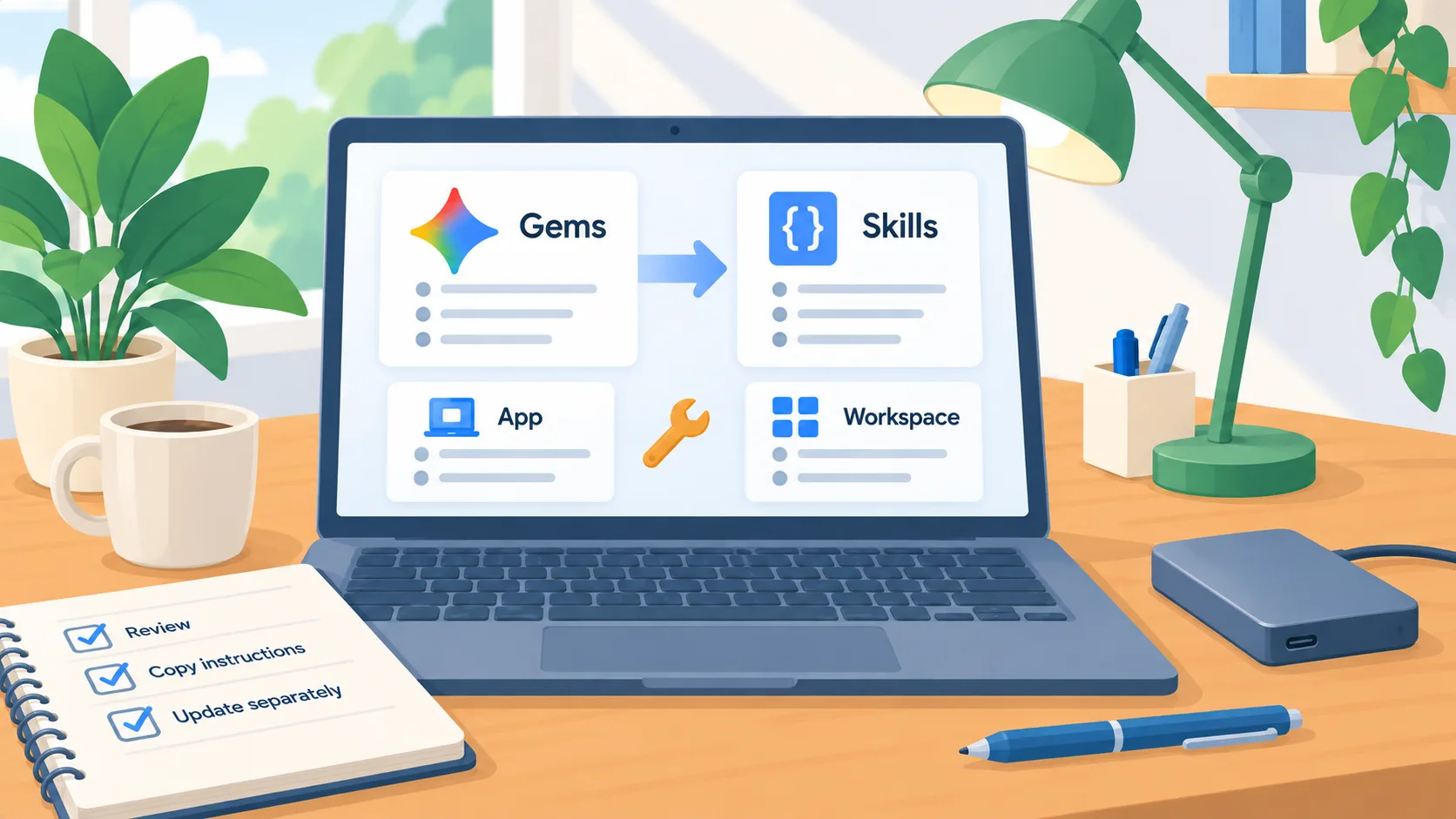
Google’s September 30, 2026 update describes Skills as reusable instructions for Gemini in the Gemini app and many Workspace apps, and sets out a gradual transition from Gems. The rollout is not one date for everyone: Workspace rapid-release domains began October 5, while scheduled-release domains are set to begin October 19; the Gemini app rollout begins October 13 and is expected to continue into mid-November. Google also says skills do not sync automatically between the Gemini app and Workspace apps. As of October 12, the October 13 Gemini app rollout is still in the future.
Inventory the work before migrating instructions
A saved prompt can look small while carrying important operating knowledge: a preferred tone, an approval rule, a required source, or a format used by another system. Before recreating it, list each Gem or saved workflow, its owner, users, purpose, source material, expected output, and where it is used. Flag instructions that are obsolete, duplicated, or relied on by a scheduled process. Do not assume that moving a prompt preserves its behavior or downstream connections.
Separate reusable guidance from information that changes. A skill can encode a stable instruction such as “summarize open items with the source and owner,” but current customer facts should come from an approved system at the time of use. Keeping current facts out of a static prompt reduces the chance that a copied instruction becomes a stale reference or exposes data to users who should not see it.
Account for separate surfaces
The absence of automatic sync means a team that uses Gemini in both the standalone app and Workspace should plan to create and maintain instructions in each place where they are needed. That creates an ownership question: who updates the canonical version, how copies are checked, and what happens when one surface changes before another? Keep a short inventory with a responsible person and a review date. For business-critical instructions, include a version label or another way to detect outdated copies.
Make a separate checklist for workflows that invoke an existing Gem. Find the staff member responsible for each flow, the inputs it receives, and the output another process expects. Preserve the working configuration while you test a replacement in a separate place. A successful prompt in a new surface does not demonstrate that a connected workflow still behaves correctly. Have the workflow owner inspect both the ordinary path and the case where an instruction is missing or outdated before deciding to switch.
Test the replacement like a process change
Choose one low-risk instruction and recreate it in the target surface. Test it on representative cases, including an ambiguous request, missing context, and an instruction that should produce a refusal or human handoff. Compare the response with the old workflow and have the instruction owner confirm that the important constraints survived. Check whether colleagues can find and use the new version and whether it behaves differently across the app and Workspace.
A successful migration is not just a prompt that still runs. It preserves the intended behavior, source boundaries, and review step in the work context where employees need it. If the new surface changes who can access the instruction or how it reaches data, review those controls before wider sharing.
Make a small migration plan
This week, identify the saved instructions that matter to recurring work and mark their current locations. Confirm your organization’s release track and the features that have actually appeared in the relevant accounts. Then select one instruction to test, document the result, and assign an owner for keeping copies aligned.
Do not migrate every Gem just because a new name has been announced. Retire unused instructions, test important ones deliberately, and leave flows that depend on Gems untouched until their replacement path is understood. The decision is whether each saved instruction still has an accountable job, not whether every artifact can be copied.