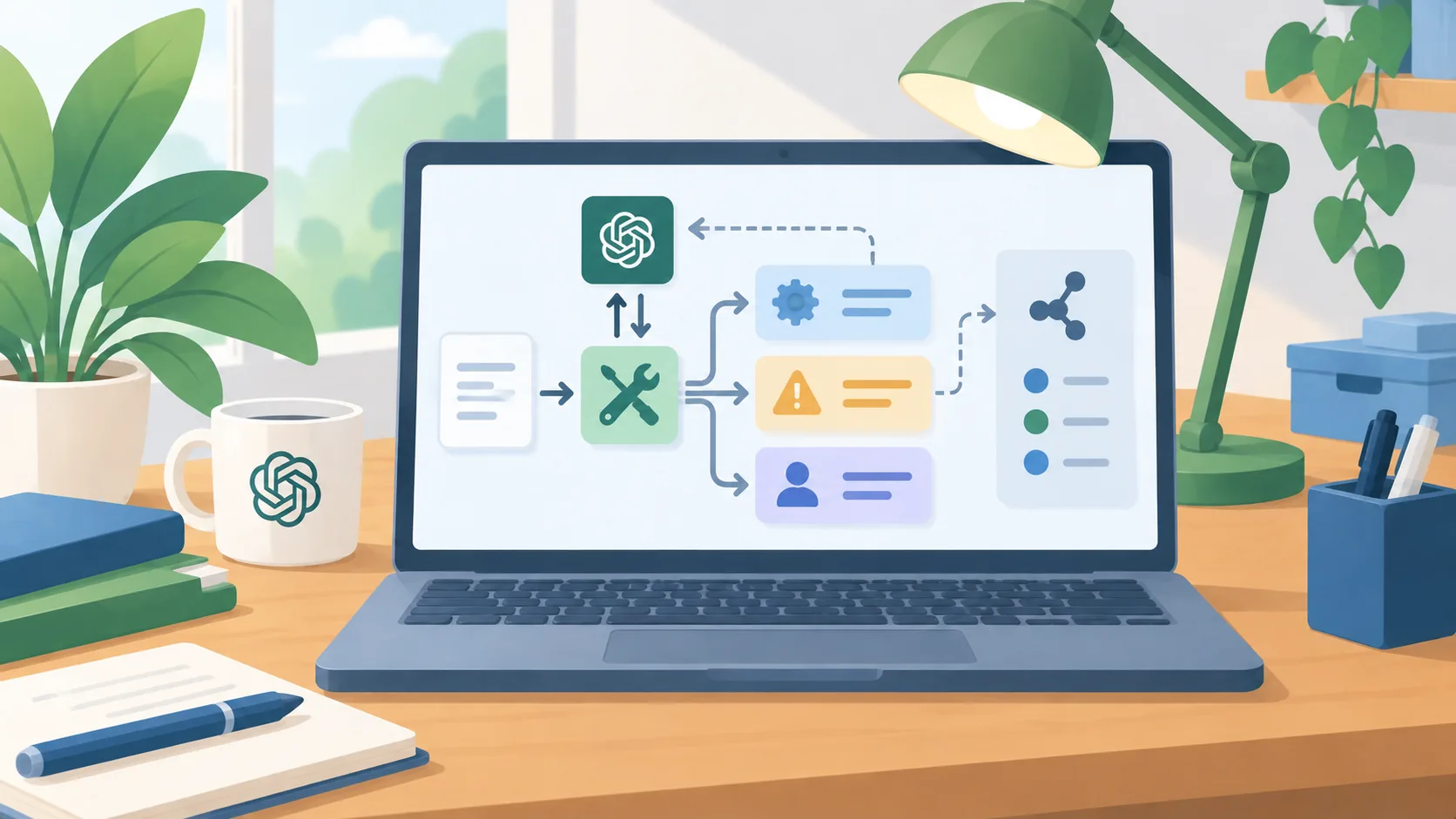
The announcement is a migration question, not a reason to switch every workflow
OpenAI’s September 3 API changelog lists GPT-6 Astra for the Responses API and Chat Completions, describes it for reasoning, coding, computer use, research, and document creation, and flags migration differences: the model does not support the “none” reasoning effort, custom temperature or top_p values, or log probabilities; tool calling requires the Responses API. The same changelog describes asynchronous tool calling and mid-turn steering in Responses API requests. Those are specific product statements, not evidence that a workflow will improve after a model swap.
For an operator, the first question is whether your existing application depends on any of those changed assumptions. A prompt can be portable while the surrounding request is not. Configuration values may be accepted by one model and rejected by another. A tool call may be wired to an API surface the new model does not support. A long-running task may need application logic to receive tool results before the work can continue. Treat the release as a compatibility review before treating it as a capability upgrade.
Inventory the contract your application actually sends
Start with a request map. For every production path that could use the new model, record the endpoint, model identifier, reasoning setting, sampling parameters, requested response format, tools, and fallback. Include any logging or evaluation code that consumes log probabilities. Search configuration and deployment settings as well as prompt files: the model choice is often stored outside the code a prompt editor sees.
Then compare the current request with the target model’s documented support. Remove unsupported parameters only when they are not part of a deliberate quality control. If a workflow uses tools through Chat Completions, decide whether to migrate that workflow to Responses or keep its current model. Do not silently omit the tool call and allow the system to answer without data. Preserve a known-good path while you test the new one.
Test the whole task, including the handoff
Use a small fixed set of sanitized examples from the real task: routine inputs, ambiguous inputs, missing fields, conflicting records, and cases that should stop for review. Define acceptable results before running either model. Compare more than prose. Confirm that structured output still validates, the chosen tool is appropriate, required arguments are present, and an uncertain or unsupported case reaches the expected human. Record the model and request settings with each run so a result can be reproduced.
If the task involves computer use or research, make the expected boundary explicit. Which page or files can the agent reach? Which action is allowed? What must be shown to a person first? A stronger capability can enlarge the impact of a mistaken instruction. Keep the comparison focused on the business job and its stop conditions, not on the number of demonstrations a release announcement can show.
Roll out behind a reversible boundary
First run the candidate against saved examples without allowing it to write to business systems. Next, use a staging account or a limited internal queue where a person can inspect every result. Compare completion quality, corrections, latency, failures, and review effort. Do not call an early sample a performance benchmark. It only tells you whether the candidate deserves a broader test.
Keep the previous model configuration available and identify who can switch it back. Watch for failures that tests rarely capture: request validation, tool timeouts, retry behavior, output formatting, and downstream assumptions. If there is no clear operational benefit, do not migrate simply to be current. The useful decision may be to wait, or to use Astra only for a bounded task that benefits from its documented capabilities.
A decision record prevents accidental migration
Write down the exact workflow, current and candidate settings, test cases, acceptance rules, unresolved risks, and rollback owner. Make clear whether a model change is a code release, a configuration-only change, or a trial with no production actions. Revisit the record when the provider changes model behavior or when the business task changes. A model announcement is a dated input to that decision, not a substitute for it.
For a team without a clean request inventory, the first improvement is to map one workflow end to end. Once the inputs, tools, output contract, and human checkpoints are visible, it becomes much easier to tell whether a model switch is low-risk maintenance or a real system change.