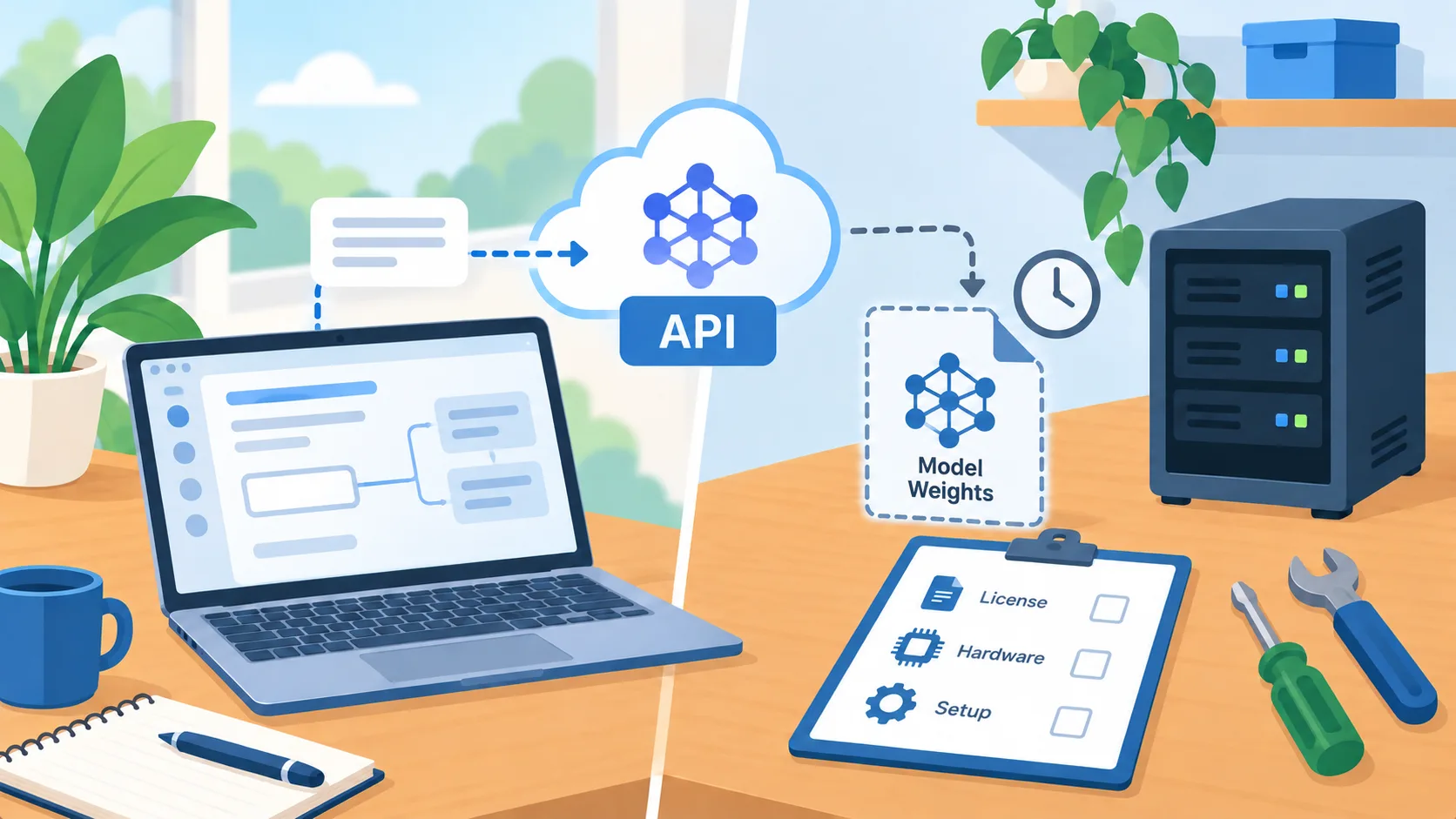
The announcement described two different access paths
Alibaba announced Qwen3.8-Max on August 3 and said developers could use it through the Alibaba Cloud Model Studio API. The same release said the model weights were scheduled for release the following week. Those are separate availability states: an API can be accessible while the weights are not yet available for a team to download and run. Alibaba also described the model as multimodal and reported a context window up to one million tokens. Those are vendor claims; they do not establish the quality, cost, or suitability of your own use case.
Alibaba’s dated announcement gives a buyer two separate milestones to track: access to a hosted service and the planned publication of files for a self-managed deployment. The choice depends on the route your team can actually use, its applicable terms, and its operational requirements. Confirm those points before basing a project on parameter counts or a future weights plan.
Decide what your deployment requirement really is
Write down why your team wants a model. If the objective is to test a workflow quickly, a managed API may be the simpler evaluation path, provided its data terms and service controls meet your requirements. If the objective is to run in a controlled environment, a promised weights release is not enough. You will need the actual files, a license that permits your intended use, adequate hardware, a serving stack, security updates, and someone responsible for operations.
These are different projects with different costs and dependencies. A hosted model shifts infrastructure work to the provider but creates reliance on its service, pricing, availability, and terms. Self-hosting can offer more control over where inference runs, but it transfers maintenance, capacity planning, and reliability work to your team. A model name does not tell you which route is best. Make the requirement explicit before comparing options.
Evaluate the API on a bounded task
Choose a low-risk workflow that benefits from the capabilities the release describes, such as summarizing a long internal manual or extracting information from a batch of approved documents. Use a sanitized sample and compare the results with the current method. Measure whether the answer is complete, whether it identifies missing context, and how much human correction is needed. If a long context window is relevant, test with realistic material rather than assuming that the maximum advertised size improves a result.
Check the provider's API documentation for supported formats, limitations, data controls, and usage terms at the time you test. Confirm that the model identifier and account route match the release you are evaluating. Do not rely on creator claims for benchmark rankings or per-token pricing; check the provider’s current official console and terms directly before estimating a budget.
Keep future weights separate from today's decision
If local deployment is a hard requirement, put the planned weights release on a watch list and wait to confirm the files and license. Verify whether the release is complete, whether it includes all components needed to run the model, and whether the license permits commercial use and redistribution if those matter. Test the intended runtime and hardware with a limited proof of concept before promising a rollout date or availability to colleagues.
If local deployment is optional, the API can still be evaluated under a controlled test, with a separate review of data transfer and retention. Keep the outcome of the API trial independent from any later weights review. A successful hosted pilot does not prove that the self-hosted version will have the same performance, tooling, or maintenance burden.
Make the decision from evidence, not the model label
Assign an owner to confirm availability, terms, and technical requirements, and another to judge the workflow result. Write down whether the experiment is testing a hosted API, a local model, or both. If the feature fails the data or quality requirements, stop or choose another route. If it succeeds, record which deployment was tested and what conditions made it acceptable.
Qwen3.8-Max's August 3 release is a useful reminder that an API launch and a weights release are not the same milestone. Business owners can avoid false starts by confirming the path they can use now and evaluating future options only after their materials are actually published.