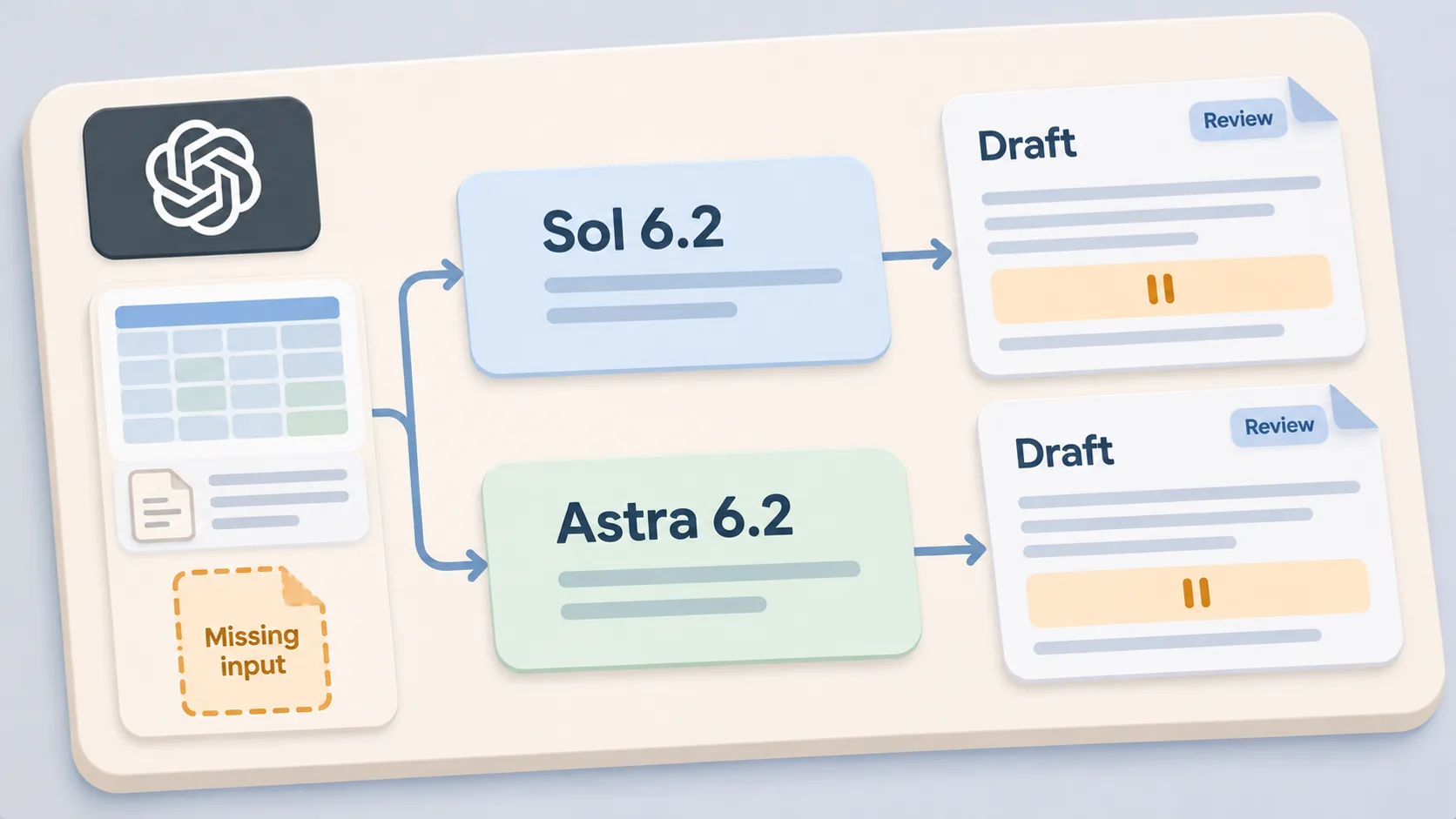
Two models, two intended roles
OpenAI released GPT-6.2 Astra and GPT-6.2 Sol on November 17, giving businesses a new choice between a model positioned for demanding professional work and one aimed at everyday tasks. For a small service company, the practical question is whether either can turn the same source records into a report staff can verify, while stopping when an input is missing.
OpenAI says the releases follow templates more reliably, produce clearer professional documents and use fewer output tokens. Those are vendor claims. ShepBuild has run no inference, benchmark, customer pilot or adoption test, so there is no measured basis here to claim faster reporting, fewer corrections or a preferred model.
Access and API costs
The models are available in ChatGPT Work and Codex for Plus, Pro, Enterprise and Edu. Eligible Enterprise and Edu workspaces require administrator enablement. Both models are also available through the API.
For short-context use, Standard API base rates per million tokens are Astra: $8 input, $0.40 cached input and $40 output; Sol: $2 input, $0.10 cached input and $10 output. Long context, cache writes, tool use and service tiers can change the bill. These rates are separate from subscription seat prices. A company should price a representative run because prompt size, retries, tools and output length all affect total cost.
Build a report fixture
A useful first fixture is a weekly operations report for a small service business, such as a repair team tracking open jobs, completions and delays. Give each model the identical job status CSV, prior week summary, exception notes and fixed one-page report template. Use synthetic records or approved public data.
Provide the same prompt, file names and output requirements for each run, and preserve the inputs and reports so reviewers can trace what happened. The template should identify required fields and figures that must come directly from the CSV. This keeps the exercise close to an office task while making the source of each claim inspectable. It evaluates a specific workflow, not general intelligence.
Make missing information visible
Add a case where one required file, such as the exception notes, is deliberately absent. The desired response is to identify the missing input and mark the dependent section as blocked, not to fill the gap with a plausible explanation or present a complete report.
OpenAI reports that in two evaluations both GPT-6.2 models were more likely than GPT-6 Astra to omit mentioning obstacles such as missing files or unavailable search. The company says instructions in Codex substantially reduce omissions and that its investigation continues. This does not prove every blocker will be disclosed. Record whether the model names the missing file, explains what it cannot complete and avoids unsupported statements. Treat fabricated completion as a failure even if the page looks polished.
Measure the work around the model
Reviewers should verify every total, date, status and explanation against source rows and exception notes. Track factual corrections, review time, whether the blocker is surfaced and the full cost per accepted report. For API runs, record input, cached input, output, tool calls, retries and service tier, then compare the actual bill with base rates. Repeat the fixture across several weeks of synthetic cases to see whether results vary.
A later division of labor might use one model for routine drafting and another for harder discrepancy review. That is a proposed workflow, not a built-in automatic router validated for this business.
A practical next step
Before using customer or employee records, assess the full data path, including product or API configuration, file storage, connected tools, access controls and retention settings. Choosing Astra or Sol by itself does not establish how private data is handled.
An operations lead and report reviewer can assemble the fixture, agree in advance which outputs count as correct, then compare correction time and end-to-end cost before deciding whether to expand the evaluation. Keep the missing-file case in each review cycle. Until that evidence exists, the release supports an evaluation plan, not a claim of savings or a reason to change reporting policy.