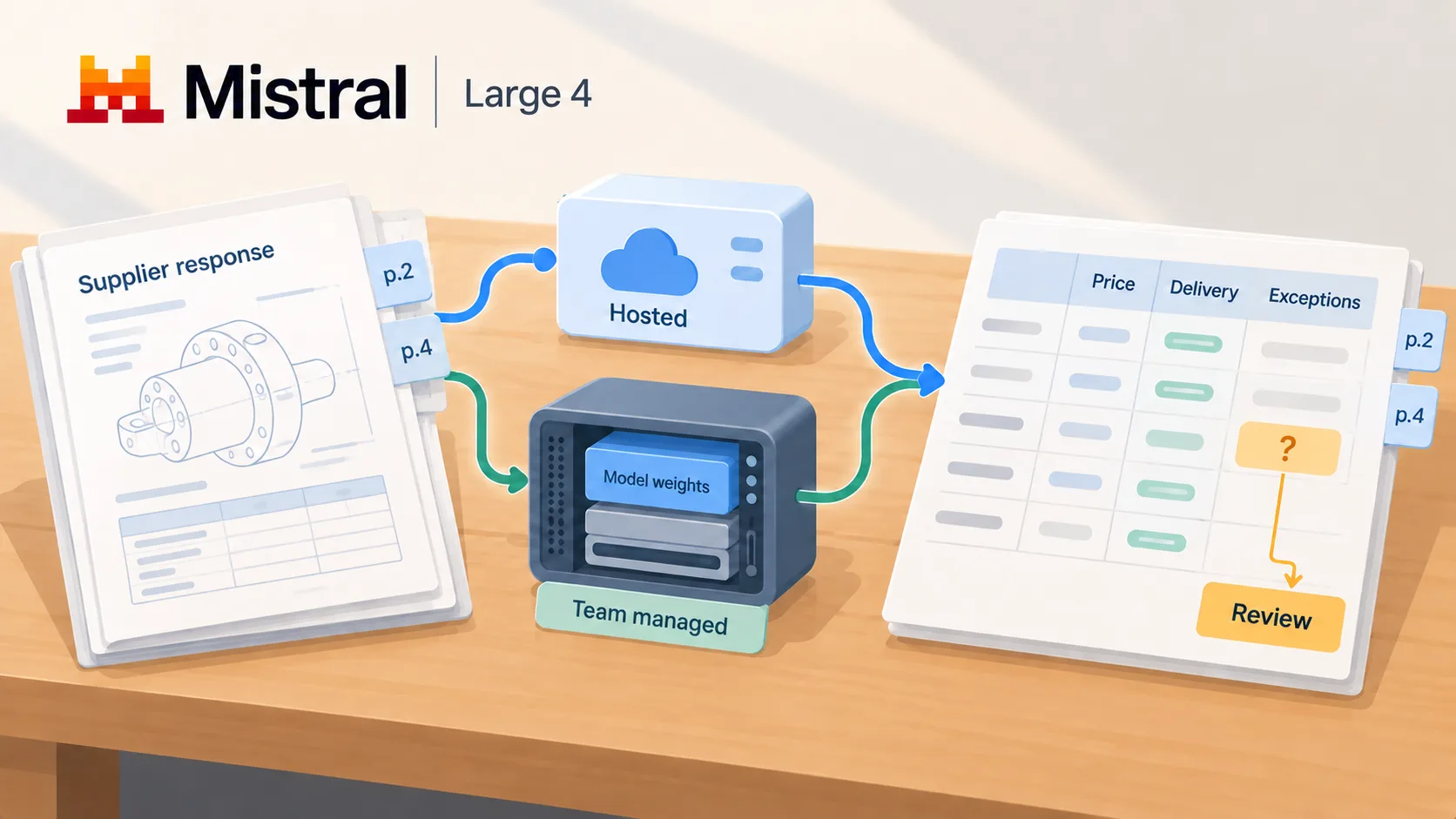
What changed on October 29
Mistral announced that the improved weights for Mistral Large 4, previously introduced in a public preview, were available to download on October 29. Its announcement also listed hosted access through Mistral Studio and API, OpenRouter, NVIDIA endpoints, and Microsoft Foundry. These are distinct services; confirm the model identifier and route with the provider before planning a trial.
The official card describes a multimodal mixture-of-experts model with about one trillion parameters in total and 49 billion active per token, or 52 billion counting embeddings and output layers. Those figures describe model structure, not checkpoint size or serving requirements.
Mistral publishes FP8 and separate NVFP4 checkpoints, with serving examples for vLLM and SGLang. They are vendor starting points, not universal machine specifications or evidence of a tested setup.
Who can use it, and when
A business can assess two routes: send approved work to a hosted service, or have an engineering team investigate operating the downloaded weights. Hosted access may simplify a bounded review, subject to current service terms, account eligibility, and data requirements. Self-managed serving adds work for deployment, updates, capacity, monitoring, and recovery. A team considering the latter must examine its chosen repository revision and serving instructions, then determine whether it can keep that stack working.
The routes are not interchangeable. They may differ in configuration, controls, latency, and support. Open weights alone do not establish where a workflow runs or what happens to its data. Check the exact service and terms before a document trial.
Use one supplier packet to make the comparison concrete
Imagine a purchasing team that receives several supplier responses to the same request. Each response includes a quoted price, delivery window, proposed substitutions, warranty language, and supporting page references. The team wants a first-pass comparison sheet, not an autonomous purchasing decision. This is a document analysis task, distinct from running a coding agent or searching a collection of embedded documents.
A useful evaluation gives the hosted route and any self-managed route the same sanitized packet and asks for the same fields. Require each proposed value to point to a page or section, preserve the supplier’s wording for exceptions, and mark missing or conflicting information instead of silently filling gaps. For example, flag a delivery date that differs between a summary and a schedule, and keep any substitution visible beside the quoted price. Keep the same output format and human review step. Then reviewers can compare extraction completeness, traceability, correction effort, and whether important caveats remain visible.
This tests the purchasing team’s document task without assuming that a parameter count or model label predicts answer quality.
What the comparison can and cannot tell you
Record the model variant, serving route, document set, instructions, output schema, reviewer corrections, and unresolved exceptions for each run. Otherwise two runs may appear comparable while using different setups. Reviewers can note whether each value is supported by a source location and whether a correction was needed, without turning the exercise into a broad model ranking.
The release and model cards provide no supplier-document results, and this article reports no test, API call, or deployment. The NVFP4 card names Blackwell systems as its target; this is format guidance, not a general minimum. Do not turn active-parameter counts into storage or GPU estimates.
A practical next step
Assemble a small supplier packet with known answers, legitimate exceptions, and one missing or conflicting field. Define the columns and evidence rules first. Check the hosted service’s model and data handling for the intended account. If self-managed use is required, have an infrastructure owner inspect the checkpoint, instructions, license terms, and hardware before planning a pilot.
Run the route the team can support, compare its draft with source pages, and record corrections and operating effort. If hosted access meets the need, downloadable weights do not force a move. If self-managed inference is necessary, include serving and maintenance in the project. The October 29 release adds a choice; the same packet can help the team choose.