What the documentation supports
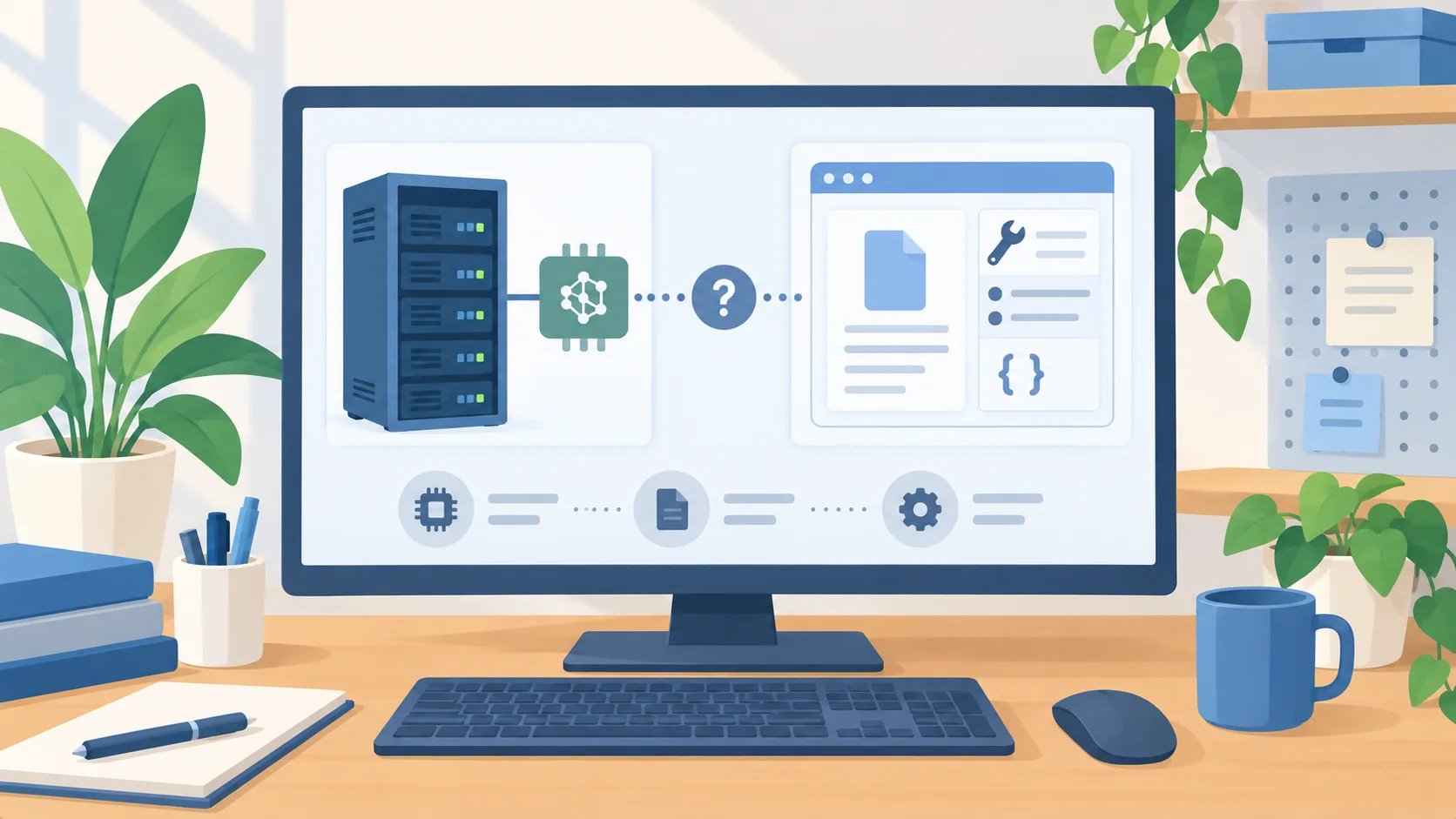
LM Studio documents a local API server and OpenAI-compatible endpoints. Its tool-use guide explains that a model can request a function call, while the surrounding application parses and executes that request. That distinction matters: a local model does not directly perform an external action just because it produced tool-call text.
The setup therefore has at least two parts to test: the model server and the agent application. A green connection indicator proves neither that the right model answered nor that the tool execution reached the intended target.
Who can use it and when
This architecture may fit an owner who has a local model, a machine able to run it, and a bounded workflow that can operate through a local endpoint. It is not automatically private if the agent uses cloud tools, external search, remote connectors, or hosted model fallbacks. Map the full request path before putting sensitive material into it.
Choose one task with a known result and a harmless sample folder. Confirm the server address, loaded model, context limit, tools exposed, and whether requests stay on the device. Do not infer any of those states from the presence of model files on disk.
Why the end-to-end check matters
A model may answer a chat prompt while failing to count files correctly, emit a valid tool schema, or use the right context length for a larger task. The agent may also pass incorrect arguments or retry without surfacing the error. These failures belong to different parts of the integration and need separate observations.
The model can request a tool, but the application decides whether to execute it. That is an opportunity to validate arguments, apply permissions, log the operation, and reject requests that fall outside the task boundary.
ShepBuild analysis
Test the complete chain with one read-only operation first: request, model response, parsed tool call, tool execution, and final answer. Compare the answer with ground truth. Then test an invalid request and make sure the application refuses it safely. Keep one receipt for which endpoint, model, settings, and tool ran.
A local server listening only on the machine is a different exposure from one bound to the local network. Review authentication and network settings before connecting another device. Also confirm how models are loaded and unloaded so an idle process does not consume resources unexpectedly.
Practical next step
Use a small evaluation sheet with a few ordinary cases, one ambiguous case, and one disallowed action. Record whether the model loaded, whether the tool request parsed, what the tool returned, and how much human correction was needed. Repeat after changing the model or server configuration.
If the task needs hosted search or cloud connectors, describe those dependencies honestly. Keep a human responsible for the outcome, and use a stronger or deterministic path when the local model cannot meet the acceptance bar.
A repeatable record makes the test useful after the first setup. Capture the model name and version, server endpoint, agent version, tool list, sample input, expected output, and observed output. Keep secrets out of the record, but preserve enough detail to reproduce the behavior. When a model or runtime changes, run the same examples again so the team can tell whether a difference came from the model, the integration, or the task itself.