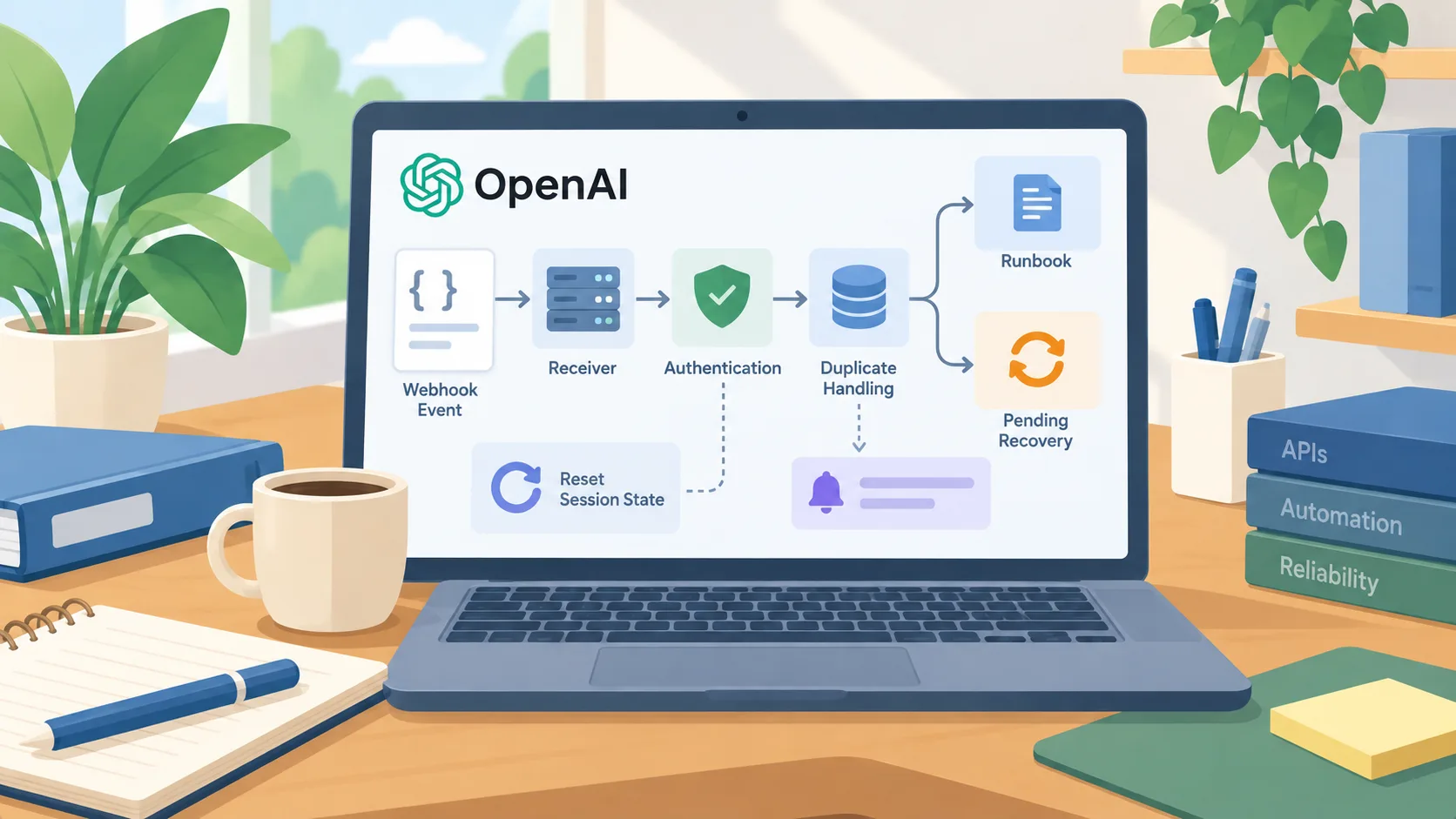
An event endpoint is only useful when someone responds
OpenAI’s Python SDK v3.17.0 release notes, dated September 22, list API additions for safety-case retrieval, safety-warning and deactivation webhook events, session-environment reset events, and external-storage configuration. A release note describes SDK support; it does not mean an application has subscribed, validated signatures, or built a staffed response path. Those are application and operations responsibilities.
If an agent can run for a long time or call tools, a warning is not a dashboard ornament. Someone needs to know which run it concerns, whether it is paused or disabled, what state has been reset, and which action must happen next. Without an owner and runbook, a webhook can be delivered successfully while the business response fails.
Decide what each event means in your system
Create an event map before adding handlers. For every event type, define the source, unique run or session identifier, expected state transition, notification recipient, and allowed recovery action. A warning may require inspection; deactivation may require stopping queued work; environment reset may require reinitializing temporary state. Do not collapse distinct conditions into one generic “agent error” message.
Make the recipient actionable. Send enough context to locate the run and determine impact, but avoid copying prompts, credentials, or customer data into an unprotected alert channel. Link to a controlled record where authorized staff can investigate. Establish who can restart a session and who must approve a retry after a safety event.
Test delivery and recovery, not just event receipt
Use a non-production environment to simulate each event path. Verify webhook authentication, duplicate delivery handling, retry behavior, event ordering, and how the application behaves if its receiver is temporarily unavailable. Check that a deactivated session cannot continue through a separate queue or stale worker. After an environment reset, confirm that temporary credentials and state are renewed as expected.
Record both the provider event and your application’s resulting action. If the event says the session was reset but a downstream worker continues with stale context, the event handler did not protect the workflow. Test whether a human sees a clear notification and can identify whether any external action already occurred.
Treat release upgrades as a chance to audit the runbook
When adopting the SDK change, pin the version and list the code path that consumes each event. Add a review date and a named owner to the runbook. Keep the existing recovery method until the new path passes testing. If the application uses external storage or custom webhook infrastructure, verify the configuration in the deployed environment rather than relying only on a unit test.
The goal is not to collect every event an SDK can emit. It is to turn important state changes into reliable decisions. Start with the event that could leave a run paused, disabled, or carrying stale context, then prove that it reaches the person who can safely resolve it. If a signal arrives after a downstream action, the runbook should tell the responder how to determine whether a record, message, or file already changed. A pause is not a rollback. Keep the event identifier linked to the affected work so the operator can stop duplicate action and route any correction to the right owner.