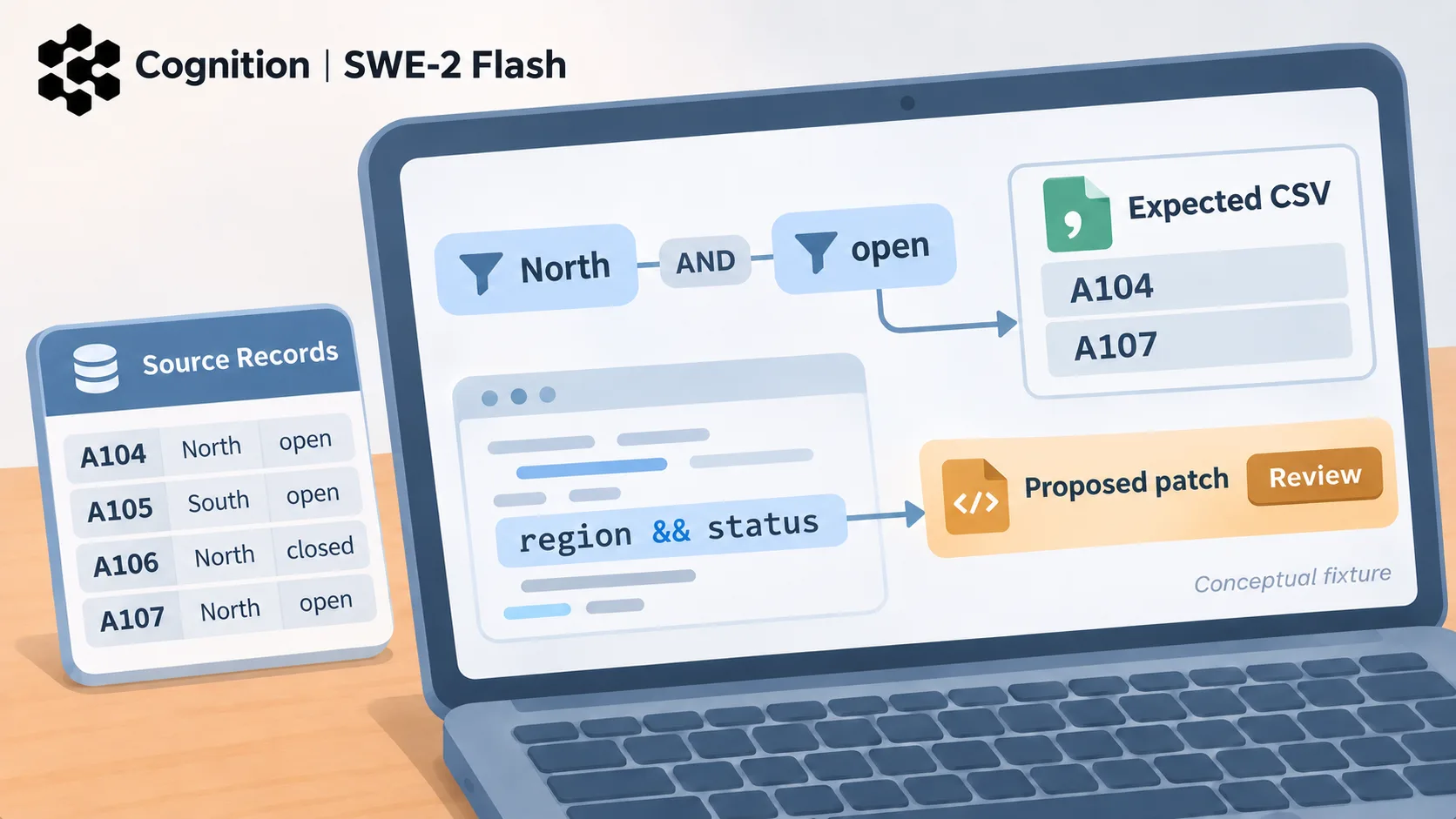
A new coding model needs a business sized test
Cognition introduced SWE-2 Flash on November 4 for everyday engineering work. It is available in Devin Desktop and CLI. Devin model documentation, checked November 7, says it is not available in Devin cloud; Free plans can select Medium, while High and Max require a paid plan. Confirm access in the account's selector.
A launch announcement cannot tell a business whether a coding model will finish a small repair. Imagine an internal order tool that exports a filtered list to CSV. Its bug is narrow enough to define before asking an AI coding assistant to propose a patch. This is a test design, not a ShepBuild run or measured result.
Write down the rows and the expected file first
Use four synthetic records: A104, North, open, 12.50; A105, South, open, 0.00; A106, North, closed, 8.25; A107, North, open, 4.00. With region North and status open, export A104 then A107, with header `order_id,region,status,amount` and two decimal places. Exclude A105 by region and A106 by status.
Define the file contract exactly: UTF-8, the stated header order, LF line endings, a final LF, and comma delimiters. Quote a field only when it contains a comma, quote, or line break; escape an embedded quote by doubling it. Check in expected bytes for both the two-row result and a no-match result. This catches a closed order slipping through or a zero amount disappearing. These are proposed inputs, not observed model behavior.
Ask for a patch that explains its path through the code
Give the assistant the export handler, filter helper, fixture, and expected output. Ask it to trace visible filters to the export function and propose a minimal patch plus regression test. One possible defect: the table applies both filters but the export query forwards only region. The fix would pass the same normalized filters to export and test included and excluded rows.
Check that the patch leaves screen queries, database writes, and unrelated reports alone. Run fixture, existing export, and integration tests. Inspect bytes for header, order, formatting, newline, and absence of A105 and A106. The suggestion remains a candidate until checks pass.
Make the repair useful to the next person
A wrong export has a concrete handoff cost: an employee may reconcile a list that omitted open orders or included closed ones, then ask engineering to trace which filter was lost. Make the regression fixture reusable by calling the same export function with North/open, South/open, North/closed, and no-match cases. The patch handoff should include the changed filter path, exact fixture bytes, and test output so the next maintainer can see what the repair protects.
If an assistant proposes a patch, judge this CSV contract: did the new test fail before the fix and pass after it, do existing export tests still pass, and can a reviewer trace the UI filters into the export query? A defect in formatting or row selection means more debugging and another handoff, even if the first diff arrived quickly. Cognition's speed and price comparisons are vendor claims, not evidence about this repair.
Access to a model is not control of its weights
SWE-2 Flash being selectable in Devin Desktop or CLI describes access through those products. It does not mean a business can download the model and run its weights on a local workstation. Cognition says public weight sharing is not available yet and describes a controlled partner and research program as work in progress. A team that requires self-hosting should treat that as an unmet requirement until the actual weights and terms are available.
Before using company code, confirm account access, repository permissions, and data terms. Start with synthetic or approved work and an inspectable patch. The question is concrete: did the tool resolve a known defect with less total effort while preserving review and deployment? Map the workflow before choosing a tool.