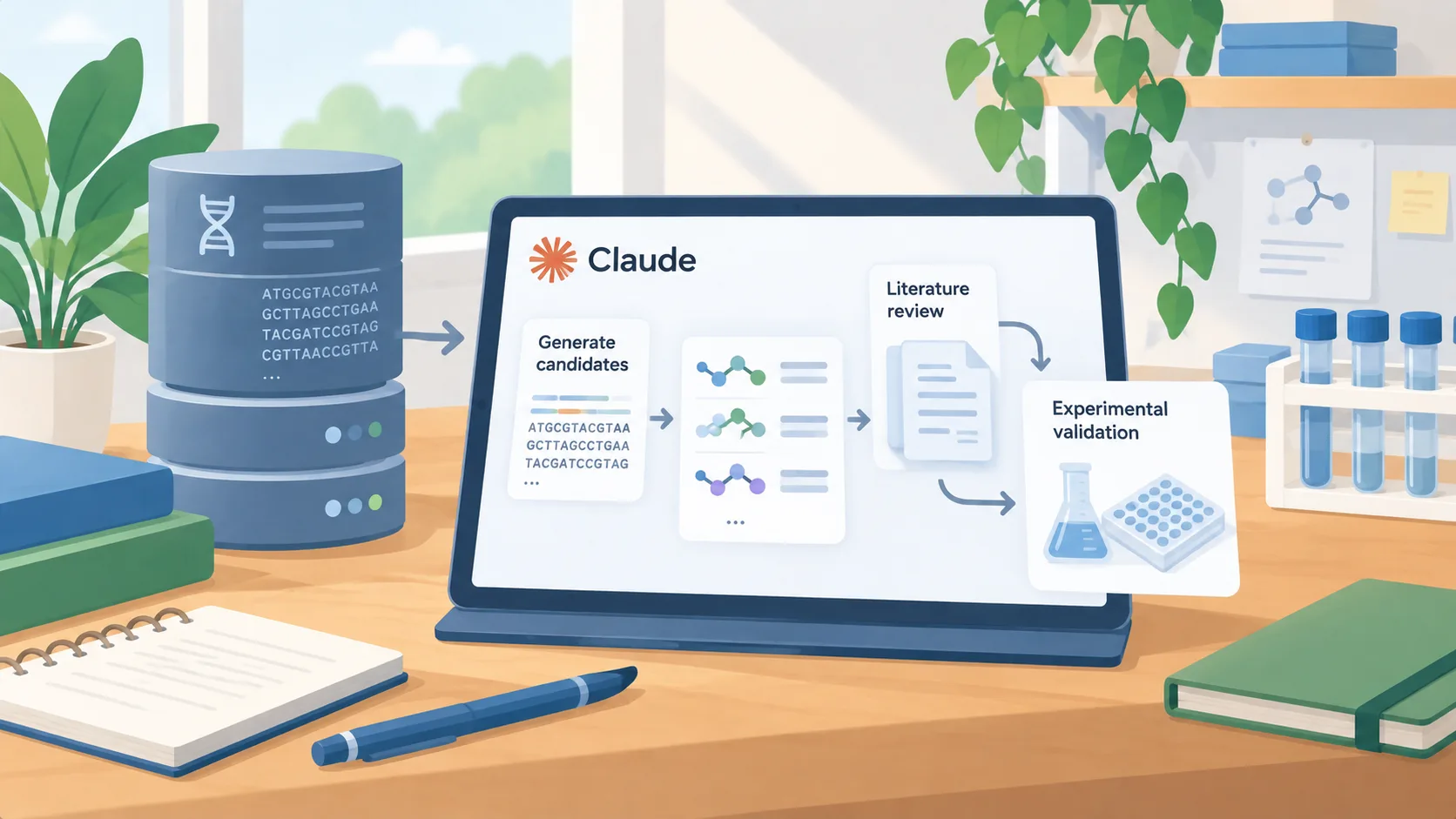
A discovery claim has several stages
Anthropic’s September 23 account describes a new research group and laboratory, then reports an early result in which Claude helped identify a previously uncharacterized enzyme system with CRISPR-like repeats. The team describes searching DNA datasets, generating hypotheses, and testing candidates in the lab. This is the company’s report of its own research, not an independent replication or evidence of a usable gene-editing tool.
That distinction matters to anyone evaluating AI in research. A model can help surface a candidate, organize evidence, or suggest a test without establishing that the biological mechanism is understood. The interesting question is not whether the system can produce a compelling story. It is what independent evidence connects the candidate to a reproducible mechanism and a useful, safe application.
Keep candidate finding separate from confirmation
For a research workflow, define separate gates for finding a pattern, checking whether it is already known, forming a hypothesis, designing an experiment, and interpreting the result. Give each stage its own owner and record. An AI-generated candidate should enter the same review queue as any other proposed lead, with links back to the sequence or literature that motivated it.
Ask the system to expose uncertainty and competing explanations rather than only argue for novelty. A second reviewer should be able to reconstruct why a candidate was selected and what evidence would disconfirm the interpretation. That discipline helps prevent an attractive pattern from being promoted directly into a public claim or an expensive experiment.
Use AI where the search space is large
The strongest early use may be triage: sorting a large collection into a smaller set for expert inspection. Before adding a model, choose a bounded dataset, a clear inclusion rule, and a human-reviewed sample of both selected and rejected items. This lets the lab measure what the tool misses and what it elevates, without pretending that a discovery workflow has already replaced domain expertise.
The review plan should include negative cases. If researchers examine only the candidates the model likes, they learn little about false negatives or selection bias. Preserve a sample of unselected records and ask a blinded reviewer to label them. Compare the model’s candidate list with that baseline before deciding whether it deserves a larger role.
Record provenance and experiment boundaries
A reproducible workflow needs the input dataset version, search criteria, model and tool configuration, candidate identifier, literature references, and reviewer decisions. Keep these records separate from sensitive or restricted sequence data where required. A later reader should be able to identify which claim came from computation, which came from a human interpretation, and which came from a wet-lab result.
If the workflow can trigger external actions, such as ordering materials, sharing results, or submitting a protocol, require an explicit approval step. Candidate ranking is not authorization to act. The person responsible for the experiment should own the decision, and a model’s suggestion should never silently broaden the approved research scope.
What a buyer or research lead should ask
Ask for the actual stage of evidence: candidate selected, mechanism tested, independent replication, or application demonstrated. Ask what the system could not establish, which parts were performed by humans, and how results were checked against prior literature. These questions apply to any AI-assisted discovery announcement, including one from a well-resourced lab.
A sensible pilot is narrow: one dataset, one research question, one explicit review protocol, and a pre-agreed definition of a useful candidate. Evaluate the time and review burden locally rather than importing another organization’s claims. The goal is a trustworthy research assistant that directs attention well, not a press-ready conclusion produced faster.