The August update moves access from individual educators to organizations
On August 28, 2026, Anthropic announced that Claude for Teachers was available to U.S. K-12 schools and districts as a free Enterprise offering. The release described district-managed accounts, single sign-on, role-based access controls, domain claiming, and a K-12 data processing agreement. Administrators can add and remove staff and set policies; qualifying organizations that sign up by June 30, 2027 can receive a year of access. Anthropic also said teacher data is not used for model training. These are vendor statements about this offer, not a substitute for a district’s own contract and privacy review.
The important change is organizational control. A teacher trying an individual tool and a district managing a system for staff face different questions. District leaders must decide which account owns the relationship, how staff are added and removed, what terms apply, and how classroom information may be used. Central administration can make access more consistent, but it also makes governance a prerequisite rather than an afterthought.
Procurement should begin with account and data questions
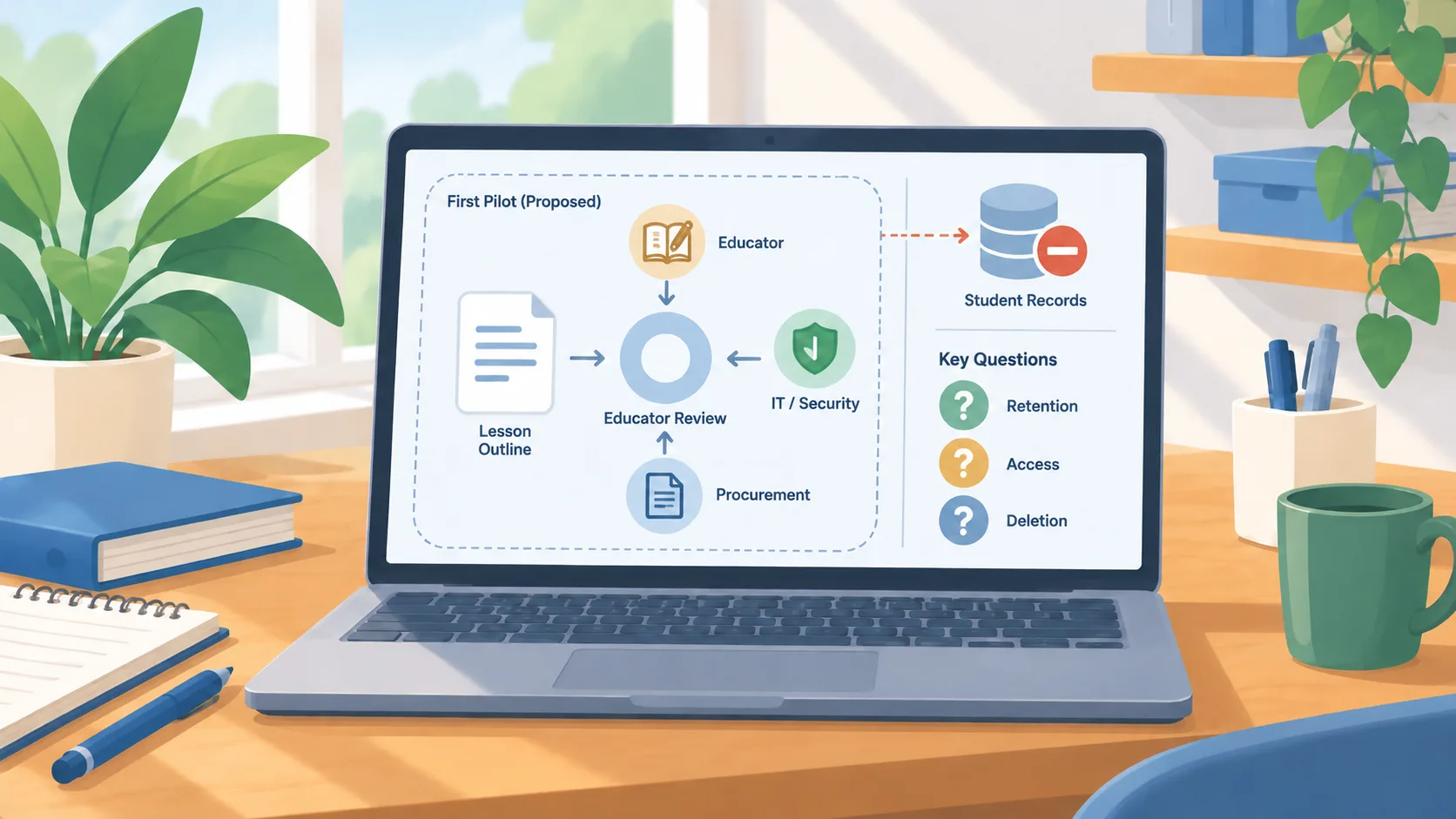
Before enabling connections to school systems, identify who will administer the tenant, who can approve integrations, and what happens when an employee leaves. Confirm how domain claiming affects educators who already have accounts on the district’s domain. Review the agreement against the district’s student data rules and decide whether the described controls cover the intended uses. A statement that data is not used for model training does not answer every question about retention, access, deletion, subprocessors, or incident handling.
Keep student-level information out of a first pilot unless the district has approved the specific data path and purpose. Start with teacher-facing work such as drafting a general lesson outline or making a non-identifying classroom checklist. Require teachers to verify standards alignment, accessibility, and factual accuracy before materials reach students. AI can prepare a draft; the educator remains responsible for deciding whether it fits the students and the moment.
Test classroom value and administrative overhead separately
A district can evaluate two outcomes at once: whether a tool helps staff complete a real teaching task, and whether the organization can operate it safely. Select a small group of educators, describe a narrow use case, and gather examples of the time-consuming steps before the pilot. Review outputs for accuracy and usability, then ask staff what still required correction. Separately test onboarding, account changes, access removal, and support escalation. A useful classroom draft does not prove that the account model is ready for district scale.
Be especially careful with student-facing or individualized outputs. A generated quiz, accommodation, or personalized explanation can affect how a learner is assessed or supported. Keep a person in the loop, use district-approved source materials, and document the review standard. If a school cannot explain which information entered the system or who checks the output, pause that use case.
A practical next step
District leaders can use the announcement to open a procurement conversation, not to skip one. Ask the vendor for current terms, data processing details, supported integrations, administrative documentation, and a clear account of the offer’s eligibility and duration. Then choose one low-risk staff workflow and establish the data boundary, reviewer, and success measure before accounts are issued broadly. The release makes centralized access available; responsible deployment still depends on the school’s own approval and operating model.