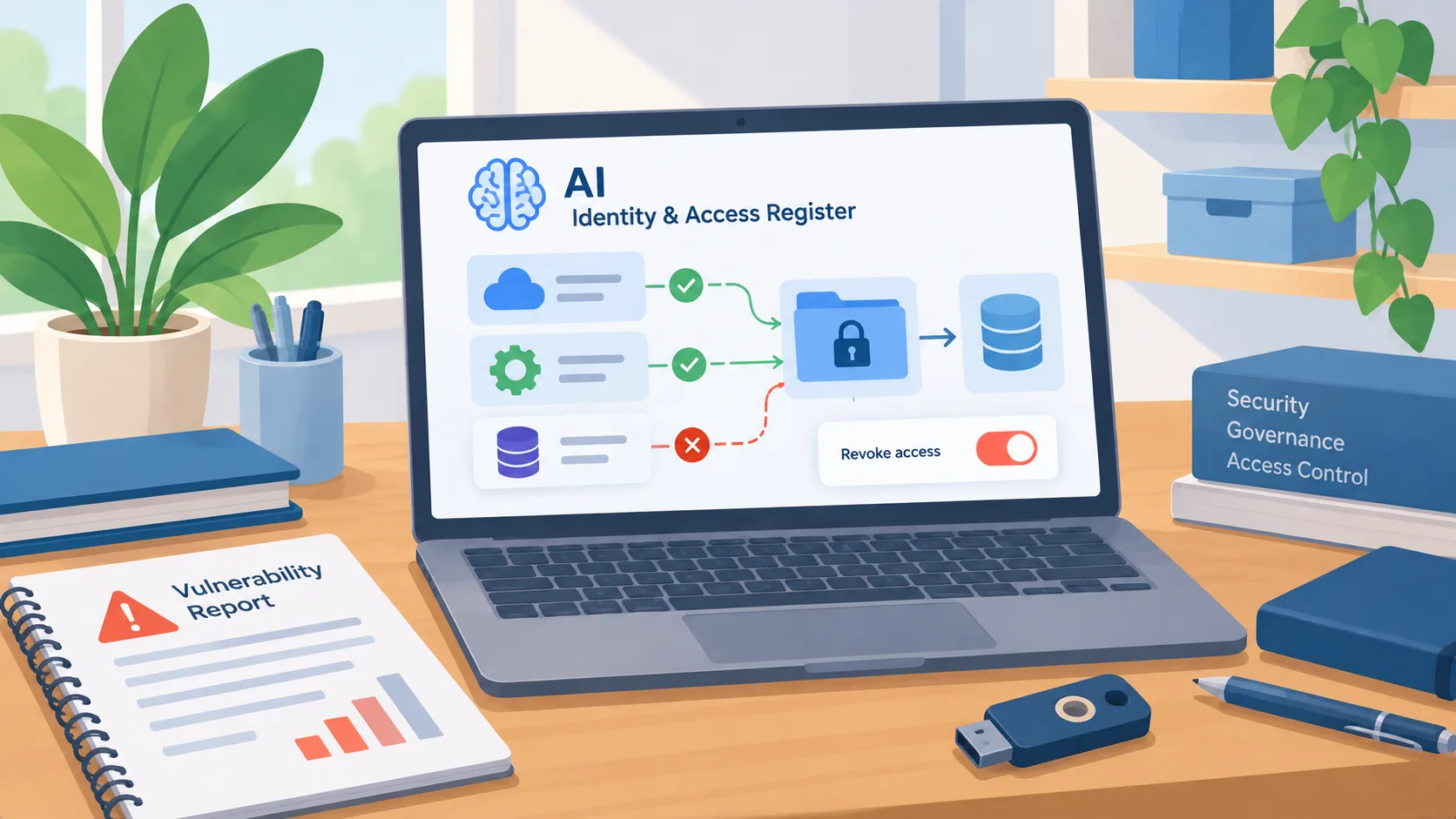
The uncomfortable finding is about access, not model cleverness
IBM published its 2026 Cost of a Data Breach findings on July 29. The headline is that AI is appearing on both sides of security: attackers use it to scale impersonation and malware, while defenders use automation to shorten response work. For a small or midsize business, the most actionable detail is less dramatic. IBM says many organizations affected by AI-related breaches lacked basic access controls for the AI applications and services involved. That points to a familiar ownership problem: teams add tools faster than they document who or what can reach business data.
The report's averages are not your expected loss, and reported savings do not prove that buying an AI security product will produce the same result. The useful signal is the control gap. If staff connect a chatbot, extension, agent, or API to email, files, records, and payments, each connection belongs in your security inventory.
Inventory the identities and permissions already in use
Start with a register of each AI service or automation, its owner, account, accessible data, allowed actions, external connections, retention settings, and revocation owner. Include tools adopted without an IT project. A spreadsheet is enough if someone maintains it. Separate human sign-ins from service accounts and API keys; a workflow may keep access after its original employee leaves.
Then look for permissions that exceed the job. A tool that summarizes a shared folder does not automatically need permission to edit it. An assistant that drafts replies should not have the authority to send them unless the business has explicitly chosen that behavior. Remove unused integrations, rotate exposed credentials, and make sure an owner knows how to disable a connection promptly. These steps are ordinary identity and access management applied to a newer set of software actors.
Test whether your response process can see an AI-related incident
A security plan is only useful if the team can recognize which AI connection is involved. Pick one likely scenario, such as a compromised employee account or an unexpected export from an AI-connected drive. Walk through how the business would identify the account, find the connected application, stop its access, preserve relevant logs, notify the right owner, and restore normal work. If no one can answer those questions, the immediate project is better visibility and a clear revocation path, not a more autonomous response agent.
Keep a record of which systems log prompts, tool actions, file access, and administrative changes. Logging must follow your privacy and retention rules, but without a useful audit trail an incident review can become guesswork. Check whether logs are actually available to the people who would respond, and whether they can distinguish a user action from an automated service action. Confirm the process with a harmless tabletop exercise rather than testing against production data.
Use automation only after ownership and boundaries are clear
AI-assisted monitoring may sort alerts or summarize evidence, but it should begin with a bounded job and a human decision owner. A system can prepare an incident summary while an authorized responder decides whether to disable an account or notify customers. Keep high-impact changes behind approval until testing shows the process behaves as intended and the organization can reverse mistakes.
Set a few practical acceptance checks before expanding the tool: it must use the intended data sources, preserve the original evidence, identify uncertainty, avoid acting outside its assigned scope, and leave a reviewable record. Include a negative test where the correct behavior is to stop or ask for help. This does not eliminate risk. It gives the owner concrete evidence about whether the automation is useful enough to keep and controlled enough to trust.
A one-week action for the owner
Ask each department lead to name the AI systems and connections their team uses, including browser add-ons and embedded features. Review the list with whoever manages identity and data. For every connection, decide whether it is approved, what access it needs, who reviews it, and how to disable it. Assign an owner and date to unresolved items.
IBM’s report is a reason to inspect the growing set of AI identities in your business, not a reason to rush into a security purchase. Start by making access visible and reversible. If the inventory reveals a workflow with meaningful exposure, define its boundary and test a narrow improvement before expanding automation.