A shared search representation for more than documents
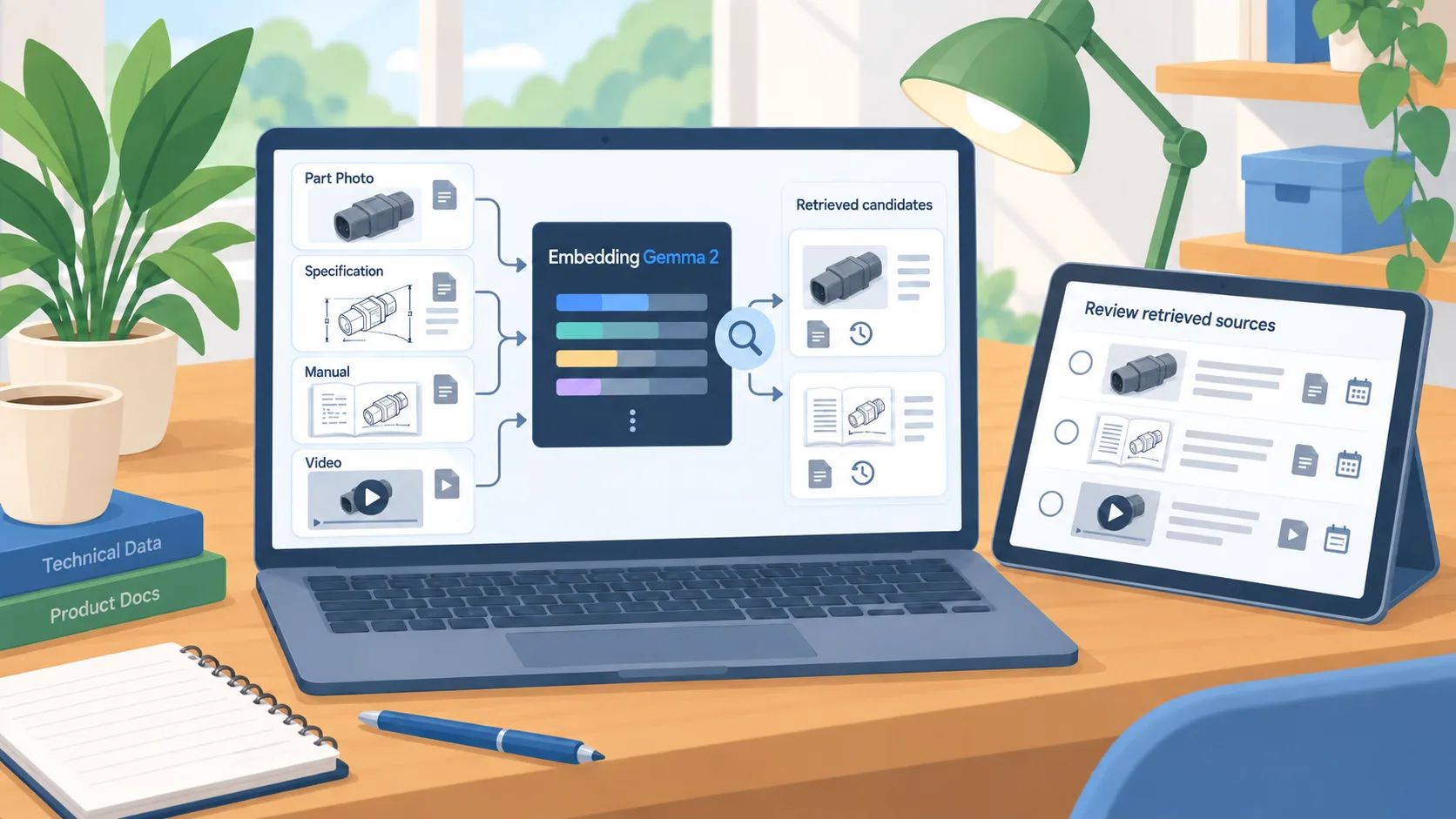
Google announced EmbeddingGemma 2 on October 6, 2026. The first EmbeddingGemma centered on text embeddings; version 2 expands the shared space to code, images, audio, and video. It describes an open model that maps text, code, images, audio, and video into a shared embedding space. Google lists 740 million parameters, Apache 2.0 weights on its official Hugging Face and Kaggle listings, and local offline retrieval as a design goal. An embedding model creates representations an application compares to find related material; it does not itself write a verified answer.
A supplier or repair shop may have specifications, part photos, scanned manuals, and short training clips. A staff member may remember a component's appearance or purpose but not the file name or exact wording. Multimodal retrieval could give them another way to locate a likely source.
Start with a small, approved collection
Choose one product family and a few dozen files the business is allowed to use: specification sheets, part photos, relevant manual pages, and perhaps a short training clip. Keep the originals and record item or supplier, document title, revision, last-checked date, and who may view each file. That context helps staff distinguish a current manual from an old copy.
Build a short set of known questions before anyone relies on the search. For each query, identify the file or files that should appear near the top. Include different ways staff might describe the same item, a query using a photo, two similar parts, and a question where the collection has no reliable match. Ask a domain owner to judge whether the retrieved source is actually relevant. A plausible-looking match is only a lead for that review.
Treat a match as a pointer, not a conclusion
An embedding model helps arrange and retrieve candidate material by similarity. The surrounding application still decides which files are indexed, how search is performed, which metadata appears, and what happens after a match. If the user needs to know whether a fitting will work with a particular machine, retrieval can surface a specification or manual section. The user or a separate application step must verify that the source names the right model and version and actually supports the conclusion.
This distinction matters when documents change. If an old product sheet and a current one use similar language, semantic similarity alone does not tell the business which version governs. Keep revision and effective-date details attached to the original source, make the current version visible, and give someone responsibility for replacing or retiring stale copies. When evidence conflicts or the correct item is uncertain, the workflow should show the sources and ask for a person to resolve the question.
Check permissions and local operation in the full design
Open weights and local-inference design may suit a business evaluating retrieval on its own equipment. But weights alone do not make an application private. Review where files, embeddings, indexes, and logs live, which users may search them, and whether another service receives content. Apply access rules before showing results, and test that users cannot discover restricted sources.
Local operation also depends on the model library, device, and deployment. Check runtime and hardware needs against the target instead of assuming parameter count guarantees an easy installation. Assess any hosted service or vector database separately. The model is one part of the search path, not the data-control plan.
A practical next step
Pick a narrow search problem and prepare a synthetic or approved test collection with known answers. Compare the current file-search process with an EmbeddingGemma 2 prototype using the same questions. Record whether the expected source appears, how often a reviewer has to correct the result, and whether the original source and revision are clear. Include queries that should return no confident match and access tests for restricted files. This is a proposed evaluation, not a ShepBuild test or a claim about expected accuracy or savings.
If the prototype helps staff find the right current source and the access controls work as intended, document the collection owner, update process, and human verification step before expanding it. If the result is unreliable, first check the source quality, metadata, indexing choices, and search design. A better retrieval model cannot repair a missing manual or decide which conflicting specification the business has approved.