What Google announced
Google announced Gemini 4 Neon on November 18, 2026, and says its rollout began that day. In its announcement, Google positions Neon for complex software engineering, knowledge work, and scientific work. The company says the model can synthesize PDFs, spreadsheets, charts, audio, and video into structured deliverables. These are Google's capability claims, not proof that each product route accepts every format or offers the same controls.
Google's November 18 rollout announcement lists the Gemini app and Google Antigravity for paid Google AI Pro and Ultra subscribers. It also lists the Gemini API paid tier in Google AI Studio, access through Android Studio, and Gemini for business via an API or model dropdown. Availability depends on rollout status and an eligible account; the announcement does not establish universal or completed access. Google's app section describes uploads such as PDFs, spreadsheets, and photos, plus report and summary creation. Nothing here establishes video upload support specifically in the Gemini app.
A focused use for a service company
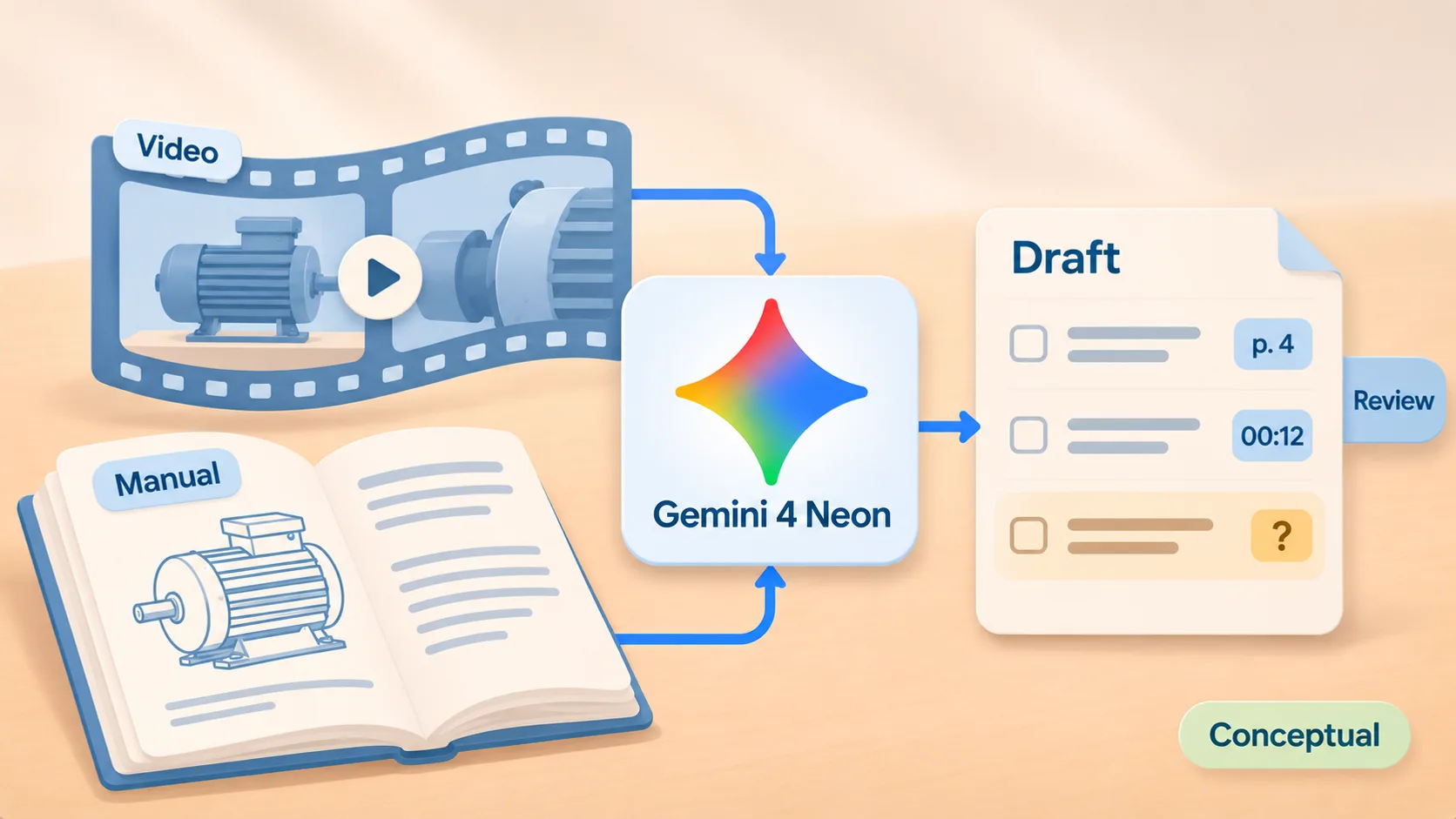
For a small service company, one possible evaluation is whether Gemini 4 Neon can help prepare a technician familiarization checklist from two permitted sources: a public equipment manual and a short, rights-cleared synthetic walkthrough video. The intended output is a draft for a qualified reviewer, with each factual entry pointing to applicable source evidence. A manual-supported entry should identify its manual page; a video-supported entry should identify its video timestamp; an entry drawing on both should identify both. The exercise would examine whether those references help a reviewer check a narrow training document.
A human-reviewed reference checklist prepared in advance can serve as a proposed acceptance test, including whether the source pointers are correct and the claims match the evidence. Citation correctness is an evaluation criterion, not a guaranteed native feature. Keep the exercise to a noncritical familiarization topic. It is not for diagnosing faults, dispatching a technician, writing operating or safety instructions, or controlling equipment.
Bound the draft exercise
Before preparing a prompt, the training owner should choose a topic with a correct reference checklist and assemble only permitted public or synthetic material. Then verify, on the intended product route and eligible account, that Gemini 4 Neon is actually available and accepts each selected file type at the planned size. Do not infer video support from another Gemini interface or Google's general description of Neon. If the intended route or file support cannot be confirmed, consult current official product documentation before running the exercise.
If the route and inputs are confirmed, ask for a draft checklist whose factual entries identify the applicable evidence: a manual page for facts supported by the manual, a video timestamp for facts supported by the video, and both when an entry draws on both sources. Preserve exact source versions and the reviewed draft. Compare every entry with its source, check for contradictions and unsupported statements, and check for omissions against the reference checklist. Leave absent, uncertain, or conflicting evidence visible for a person to review. An invented detail or unsupported entry should count as a failed exercise.
What the exercise can establish
No model run or product-route verification is reported here. A single bounded run, if later conducted, could show whether that specific route, source packet, and review process merit further evaluation. It could not establish consistent performance across equipment, manuals, video styles, accounts, or interfaces. Google's announcement is a capability statement, not evidence of outcomes for this company.
Model access alone does not establish that customer, employee, or proprietary material is appropriate to upload. If the company considers those inputs later, its data owner should review the product's data path and applicable settings before use; the model name is not a privacy guarantee. For a repeated evaluation, the company could record reviewer correction effort and total task cost, including preparation and review. These are measurements to collect, not savings or quality outcomes to assume. Keep versioned inputs, the reference checklist, draft, and reviewer corrections together so another qualified person can understand what was checked.
A practical next step
Have the training owner select one noncritical equipment familiarization topic, prepare its reference checklist and permitted source packet, and verify model and file access on the intended route. Run a bounded draft exercise only after that verification. Then review each entry against the applicable manual page, video timestamp, or both, and preserve any absent or conflicting evidence for review. This gives the company a concrete basis for deciding whether to expand the evaluation without treating Google's announcement as a completed business result.