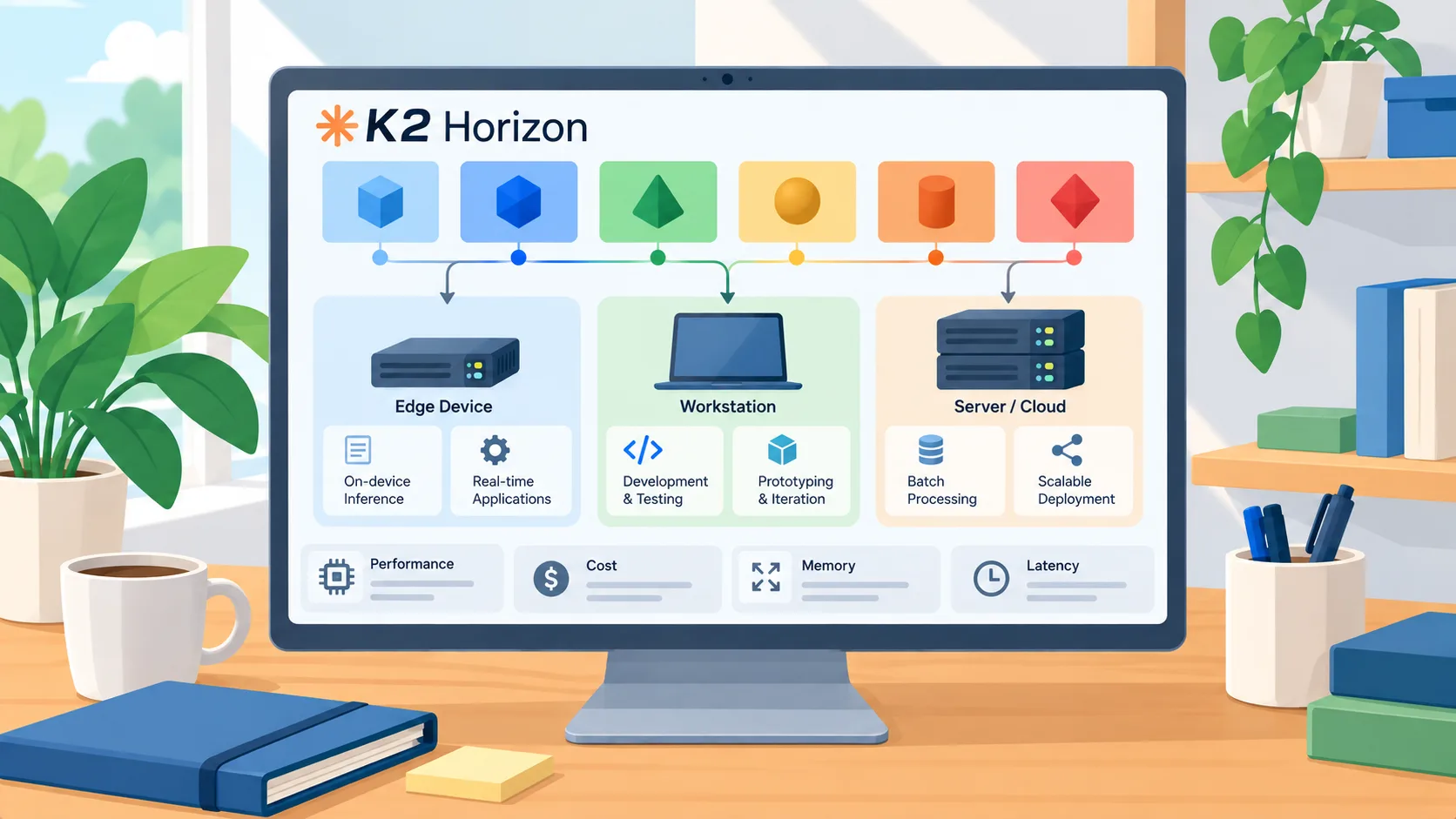
A model family shifts the selection problem
On September 3, 2026, the Institute of Foundation Models announced K2 Horizon, a six-model family ranging from 0.9 billion to 375 billion parameters. The release describes smaller variants for constrained devices and larger options for local or enterprise deployments. IFM says the package includes weights, code, training data, and methodologies, and lists access through model hosting and inference partners. Performance comparisons and claims about being best in a size class are the lab’s own claims; they are not independent measurements.
For a business choosing an open model, the headline is not simply “more choice.” It is that model size and deployment can be considered together. A small model may fit a narrow classification task on an existing device; a larger one may improve difficult reasoning but require more memory, infrastructure, and operational attention. The correct choice depends on the job, not the biggest parameter count.
Benchmark the actual workload
Write a small test set from representative work before comparing models. Include routine requests, ambiguous inputs, long documents, and cases where the model should abstain or ask for a human. Evaluate correctness and completeness, but also the time to first response, total latency, memory use, concurrent load, and recovery after a restart. Keep retrieval, prompts, quantization, and tool access consistent where possible so the comparison means something.
If the model is expected to call tools, include that in the trial. A model that gives a good answer in a static prompt may choose the wrong tool or fail to format an action correctly. Track each failure category and decide which ones are tolerable for the intended workflow. Do not convert a vendor’s benchmark into a forecast for your own task.
Budget the operational side of open weights
Open access can give a team more control over where models run and how they are customized, but the organization still owns deployment work. Someone must select an inference runtime, secure model files, handle updates, monitor performance, and plan for hardware failure. If an inference partner hosts the model, review that partner’s data handling and service terms rather than assuming open weights make the entire workflow private.
Estimate total cost with the equipment and staff time included. For a small, infrequent workload, a hosted endpoint may be simpler. For a steady or sensitive workflow, local hosting may be worth evaluating, but only after a measured pilot shows the model fits and the operations burden is acceptable. The released family can be evaluated under either approach; its existence does not decide which one wins.
Choose the smallest model that clears the bar
Build a deployment matrix with each candidate, its tested task quality, resource requirements, latency, and maintenance needs. Set a minimum quality threshold and an acceptable operating cost before you see the results. If a smaller model clears both, a larger model may add complexity without improving the business outcome. If none meet the bar, keep the workflow human-led or consider a different model class.
K2 Horizon expands the set of choices an owner can inspect. The next step is to test one bounded workflow against a baseline and preserve the test cases so a later model update can be compared honestly.