The release makes financial work part of the model conversation
Moonshot’s October 24 launch post introduces Kimi K3.1 Pro and K3.1 Pro Highspeed as available through Kimi’s products and API, subject to the relevant channel and account access. The company describes improvements in financial research and modeling. Its finance section says the modeling evaluation covers formula linkage, financial logic, and final workbook quality, while its research evaluation focuses on auditable research under evidence and cutoff constraints. These are Moonshot’s descriptions of its model and internal evaluations, not independent proof that a particular business workbook will be correct.
The access timeline also has two parts. Moonshot says the hosted products and API are available now, while full model weights are planned by November 4, 2026. A hosted API and downloadable weights create different operational choices; the future plan does not mean the weights can already be inspected or run locally.
Start with a monthly service margin workbook
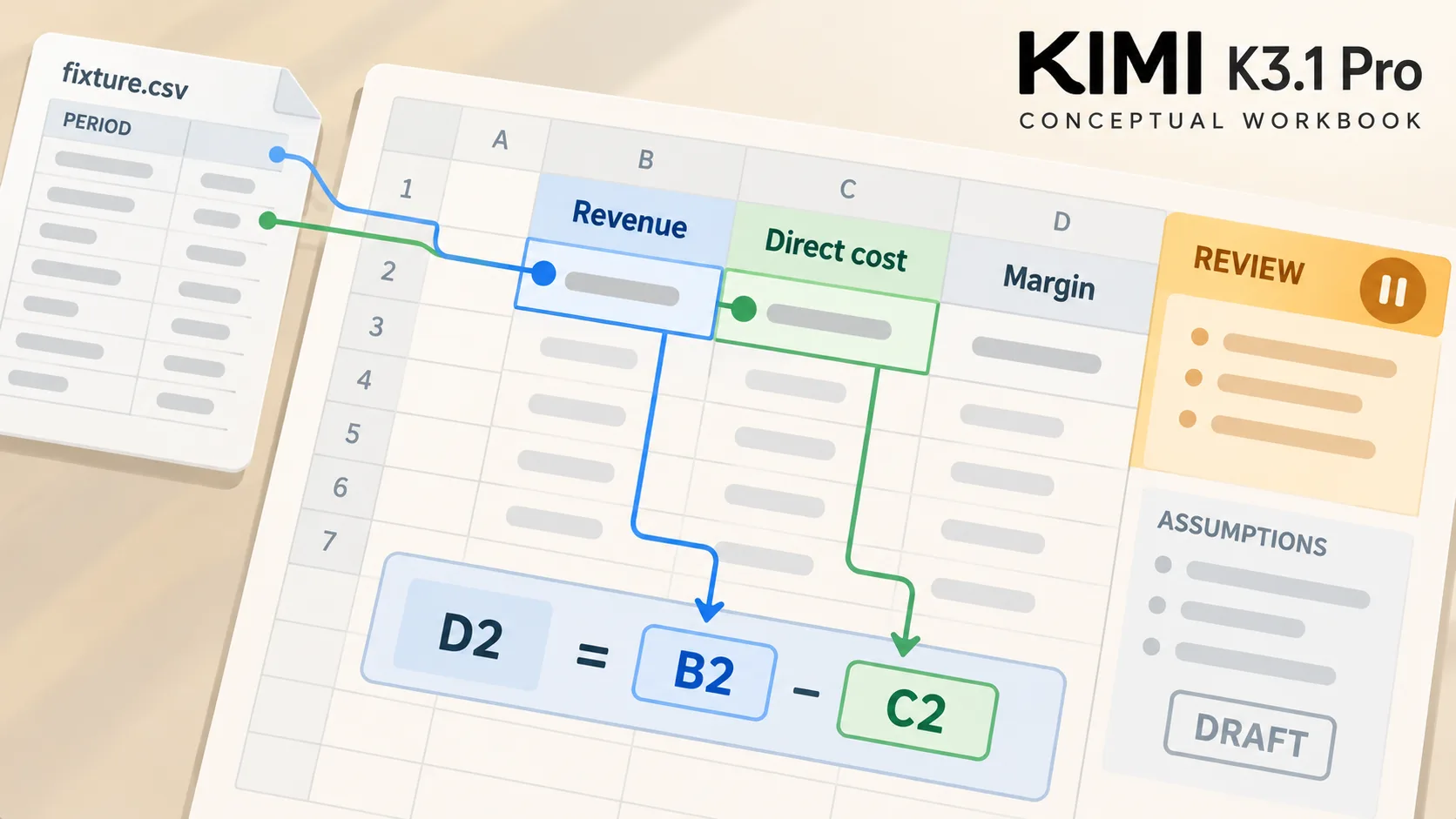
Consider a small service business that reviews monthly job revenue, labor hours, materials, and rework from a fixture CSV. A useful analysis might group jobs by service type, calculate contribution margin, flag missing costs, and explain which source rows support a change from the prior month. The model can help draft formulas, summarize patterns, or prepare a first-pass explanation. The business still owns the definitions: what counts as revenue, whether callbacks belong to the original job, and which month receives a late invoice.
This example is a workflow design, not a test of K3.1 Pro. Keep the source file unchanged, record the period and units, and put each assumption beside the calculation it affects. Kimi separately documents a hosted Docs & Sheets workflow for Excel/CSV upload, linked formulas, and .xlsx export. Its help page describes a separate product workflow and does not establish that K3.1 Pro is its backend. The K3.1 API materials describe model access and supported API patterns; they do not establish that the API itself edits Excel or CSV files.
Make every important number traceable
Before a manager uses the result, check a small set of rows by hand. Confirm that the formula uses the intended columns, handles blank or reversed entries, and applies the same cutoff dates as the source records. Verify totals against the original system and make sure percentages use a clear denominator. A polished chart can hide a wrong join or a stale export just as easily as it can reveal a pattern.
For each finding, retain the source filename and refresh time, the calculation or formula, the assumptions, and the person who approved the interpretation. A useful review asks: can someone reproduce this number from the saved input, and can they tell which business rule produced it? If the answer is no, treat the output as a draft for investigation rather than a basis for pricing, staffing, or financial advice.
Evaluate the workflow, not a benchmark headline
A bounded evaluation can compare the current monthly process with an assisted version using a copy of one low-risk dataset. Give both paths the same definitions and ask a reviewer to check missing records, formula accuracy, source links, and time spent correcting the result. Record where the model needs clarification and which errors a human catches. Do not infer local performance from a vendor benchmark or from a demonstration on a different task.
Keep access and approval visible. Use only data approved for the chosen service, limit who can alter the source workbook, and require a named reviewer before any recommendation changes an operating decision. This is especially important when several people rely on one shared spreadsheet: a generated formula can change what the team sees even if the surrounding explanation sounds confident.
Choose the deployment path after the workflow is clear
If a hosted API is suitable, confirm its current terms, data handling, pricing, and account controls before moving real business information into it. If local operation is the requirement, wait until the promised weights are actually published and review the license, hardware, serving stack, and maintenance work separately. Do not treat an API trial as evidence that a future self-managed version will behave the same way.
The practical next step is to map one recurring workbook: name its source, define its measures, list the formulas that matter, and assign the person who checks them. Then decide whether AI assistance removes a specific piece of effort without hiding the reasoning. A reviewed internal tool may help when the process needs a clearer handoff between records, calculations, and decisions.