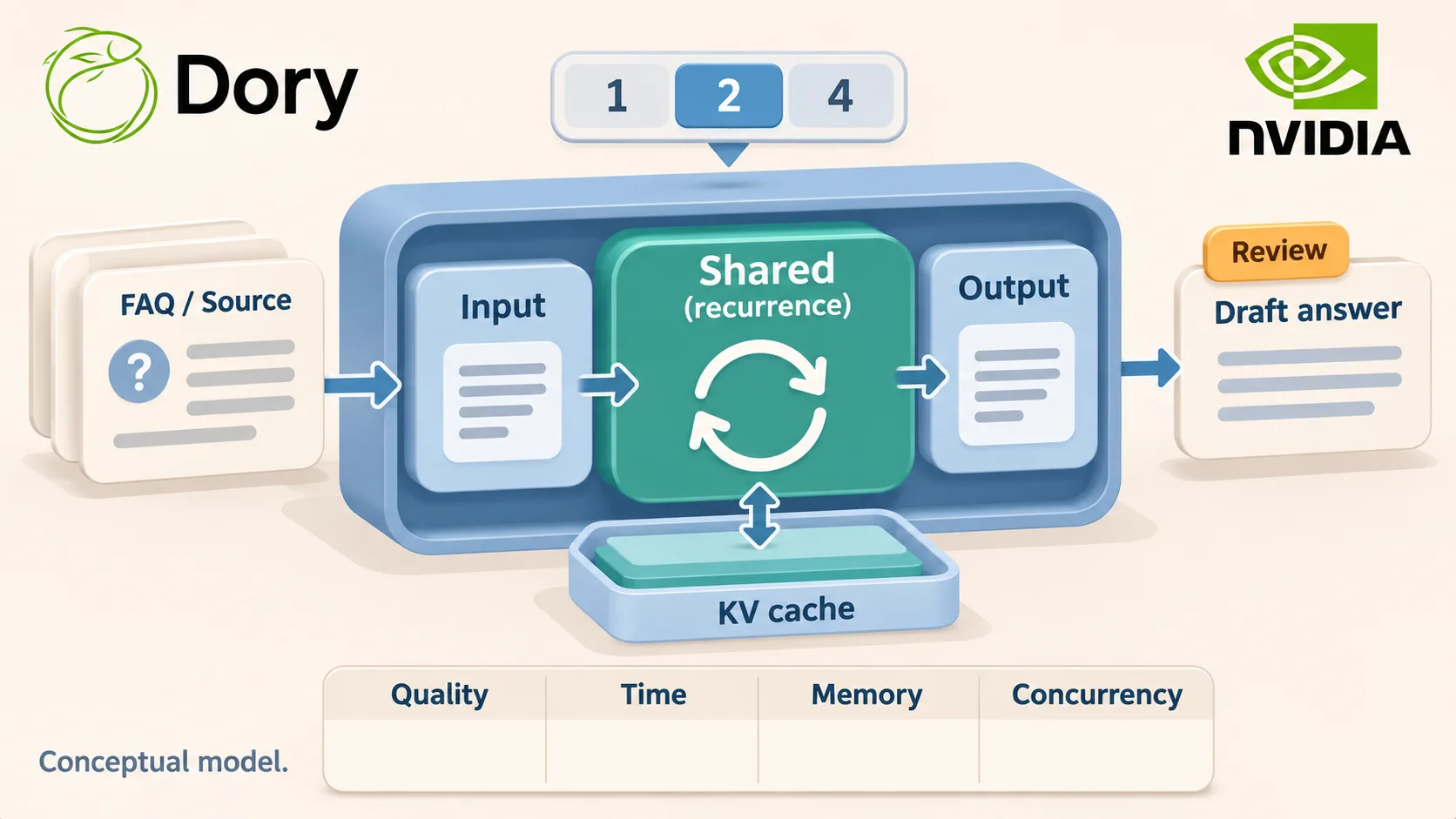
A compute setting, not a new November release
NVIDIA released its Nemotron Labs Dory 1.0 4B model on October 16, 2026. It repeats a shared middle block one, two, or four times for each token during inference. Weights stay unchanged; compute per token changes. NVIDIA recommends two loops as a starting point. Its listed license is OpenMDW 1.1; review the terms for your use.
The current upstream vLLM Dory-support PR #60149 is merged, but inclusion in a released package is unverified. The llama.cpp PR #30306 remains open and draft; the model-card example uses a fork. Confirm the compatible build before planning, since these paths are not generic drop-ins for every local chat app.
Choose one bounded job and freeze the cases
For an internally hosted FAQ drafting assistant, choose common questions and approved source material. Write expected answer points, citation requirements, and when the system should ask a person or stop. Use synthetic or cleared examples. Keep the FAQ set, prompt, checkpoint, context, sampling, output limit, and runtime fixed while comparing one, two, and four loops. Include a question with no answer in the source and one where two approved references disagree.
This compares settings for one job; it is not a model ranking or proof of wider fit. Keep the assistant in draft mode for human review. It should not send answers, update customer records, or start business processes. A loop setting is not permission to retry a consequential action. Set those cases before reviewing results.
Score answer quality beside full response time
Have reviewers who do not know the loop setting score each answer for required facts, source support, unsupported claims, omissions, and useful wording. Mark critical facts separately from style. Keep individual disagreements; an average can hide an important bad answer. Ask what kind of error would make a draft unusable, and retain those examples as test cases rather than silently changing the rubric.
Measure service latency from request arrival until the generated draft is complete, including queueing, prompt processing, and generation. Separately record staff review and correction time. If the decision concerns the complete human task, sum those components through an approved draft. Record output length and serving configuration. More loops add compute per token, while answer lengths can vary. Token speed or answer length alone cannot identify the best business result. Include the staff time needed to review and correct each draft. Set the cases before reviewing results.
Count cache and concurrency, not just weights
Per-loop caching keeps a separate KV cache for each recurrent pass, so cache use can grow with loop count. Last-loop mode keeps one cache per recurrent attention layer and overwrites earlier passes, reducing loop-related cache growth. Measure answer quality and output length with your prompts when evaluating that mode.
For each setting, record peak total memory at expected context lengths and simultaneous requests. Include cache mode, runtime, quantization, and device. Context, concurrency, and runtime affect capacity, so unchanged weights do not prove fit or responsiveness on a particular machine.
Choose the setting that clears quality and serving constraints
Compare answer quality, total response time, peak memory, and concurrent capacity. One loop can be enough if it passes review and meets serving constraints. If two loops improve answers enough to matter, decide whether measured delay and capacity use are acceptable. Try four only if the cases show a useful gain. Consider output length and total elapsed time too; a faster setting may emit longer drafts, so loop count alone does not predict task latency.
Confirm current runtime instructions, then run the cases on intended hardware with representative context and concurrency. Keep failures and reviewer corrections. An owner can then choose a setting, revise retrieval or prompts, or stop. This does not promise accuracy, latency, hardware fit, savings, or privacy; those depend on the whole system and its data path.