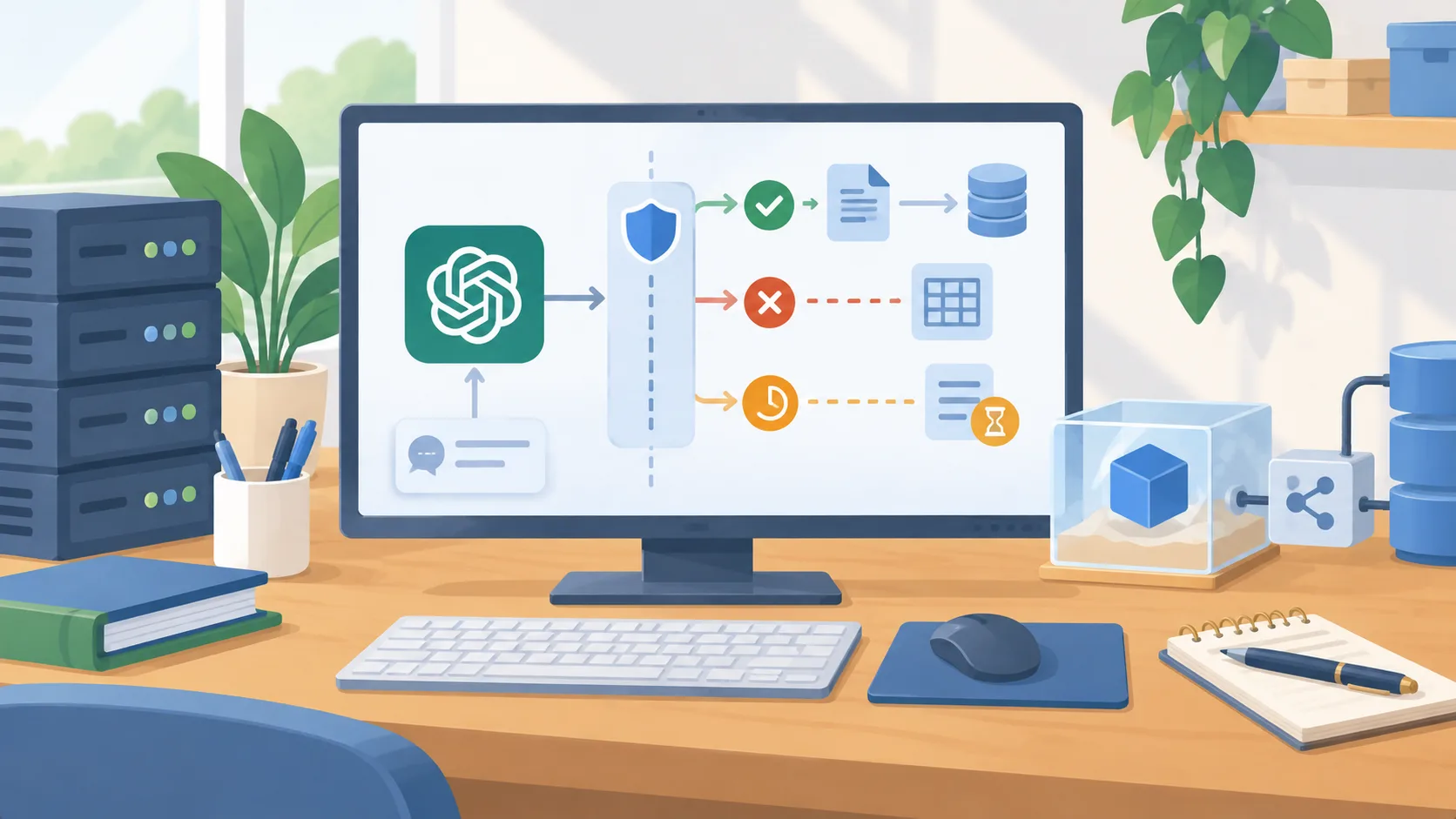
A guardrail feature creates a test question, not proof of protection
OpenAI’s Python Agents SDK v0.22.1 release was published September 8. The release notes list server-wide guardrails for MCP tools, customizable messages when an output guardrail blocks a result, configurable Unix-local environment isolation for sandboxing, Docker sandbox labels, and a fail-closed fix for empty tool arguments. These are SDK changes. Their effect in a business application depends on how the application constructs agents, servers, tools, and error handling.
The practical question is not simply whether a guardrail object exists. It is whether every path to a consequential action passes through the intended check, including calls initiated by different agents or tools. A policy can be configured correctly in one path and bypassed by a second integration or direct API call. The release is a good reason to review those paths, especially where MCP tools can read or change business records.
Write down the rule before wiring the check
Choose one rule with a clear expected result. For example, a tool may be allowed to read a test record but prohibited from changing a real customer record unless a named person confirms the proposed change. Define the scope precisely: which users, records, environments, tool names, and operations are covered? Specify what should happen when required context is missing or a policy check fails. “Be careful” is not an executable acceptance rule.
Map how the application reaches the tool. List the agent, MCP server, credential, tool, and downstream system for each path. If an operation can also be reached outside the agent, decide whether the rule belongs at the agent layer, the server layer, the business API, or more than one. A control at one layer should not be assumed to protect alternate paths unless the architecture enforces that boundary.
Test allow, deny, and failure behavior
Use synthetic data in a non-production environment. Include an allowed request that should pass, a prohibited request that should be blocked, and a malformed or incomplete request where the outcome should be safe. Verify the tool’s actual side effect, not just a message shown in the chat. Confirm that an output guardrail’s blocked message is understandable to the reviewer without leaking sensitive details, and that a retry cannot accidentally turn a denied operation into an allowed one.
Test the rule across the agents and entry points that share the server. A server-wide control is valuable only if it is applied to the calls you expect it to govern. Capture the request, identity, decision, tool response, and any resulting state change. Then test a second request with different permissions to confirm that an allowed caller cannot be inferred from an earlier session or stale context. Keep these checks proportionate to the action’s impact.
Make failures visible to people who can resolve them
A blocked action needs a useful next step. The person reviewing it should know which operation was stopped, what information is missing, and who can approve or correct it. Avoid error messages that encourage staff to paste sensitive data into an unrelated channel or repeatedly retry. If the SDK returns a custom blocked message, assess it as part of the workflow and make the owner responsible for keeping it current.
Also decide what your application does when the guardrail itself errors or times out. The safe behavior for a report-generation action may differ from the safe behavior for deleting a record or sending a notice. Document whether the operation stops, waits for human review, or follows a read-only fallback. Never treat the presence of a timeout handler as evidence of correct failure behavior without exercising it.
Promote only the tested policy path
Record the SDK version, configuration, policy, test cases, expected outcomes, and approver before the production rollout. Keep the prior deployment available for rollback, but remember that reverting code does not necessarily restore external state changed by an earlier run. Review logs for enough context to investigate decisions while minimizing retained sensitive data.
The release makes some useful enforcement and sandboxing controls available in the SDK. The business value comes from a verified rule at the right layer, with observable denials and a human path for exceptions. Start by proving one narrow boundary end to end. Expand only after you know which system actually enforces it and how the workflow behaves when the rule blocks an action.